A lot of small business owners hear the phrase “lead generation agency” and picture the same thing: a company that somehow brings in more leads so sales can grow. That is partly true, but it is also incomplete.
A real lead generation agency should do much more than send over a list of names or run a few outreach campaigns. For a small business, the right agency is supposed to help create a more reliable system for getting in front of the right buyers, starting better conversations, and moving opportunities through the pipeline with more consistency.
That distinction matters. Because if a small business hires an agency expecting magic, and the agency delivers activity without structure, the business usually ends up disappointed. More emails get sent. More calls get made. Maybe a few leads come in. But nothing about the underlying sales engine actually improves.
At Upwind, we think about lead generation differently. We do not see it as a disconnected service sitting off to the side of the business. We see it as part of the larger revenue system. That means the goal is not just to create attention. The goal is to create qualified opportunities in a way the business can actually use and scale.
So what does a lead generation agency actually do for a small business? The real answer is a lot more operational than most people expect.
What A Lead Generation Agency Is Really Supposed To Do
At the highest level, a lead generation agency helps a small business create more sales opportunities. But that answer is too broad to be useful.
The better answer is that a lead generation agency should help the business build a repeatable way to identify the right buyers, reach them effectively, capture interest, and support the follow-up process that turns attention into revenue.
That is why good lead generation is never just about lead volume. If the targeting is weak, the leads are weak. If the follow-up is slow, the opportunity dies. If the CRM is a mess, nobody knows what is happening. If the outreach message is generic, the campaign underperforms. What looks like a lead generation problem is often really a sales systems problem.
A strong agency understands that. It knows that small businesses usually do not need random activity. They need a way to create more predictable pipeline without forcing the owner to hold the whole process together manually.
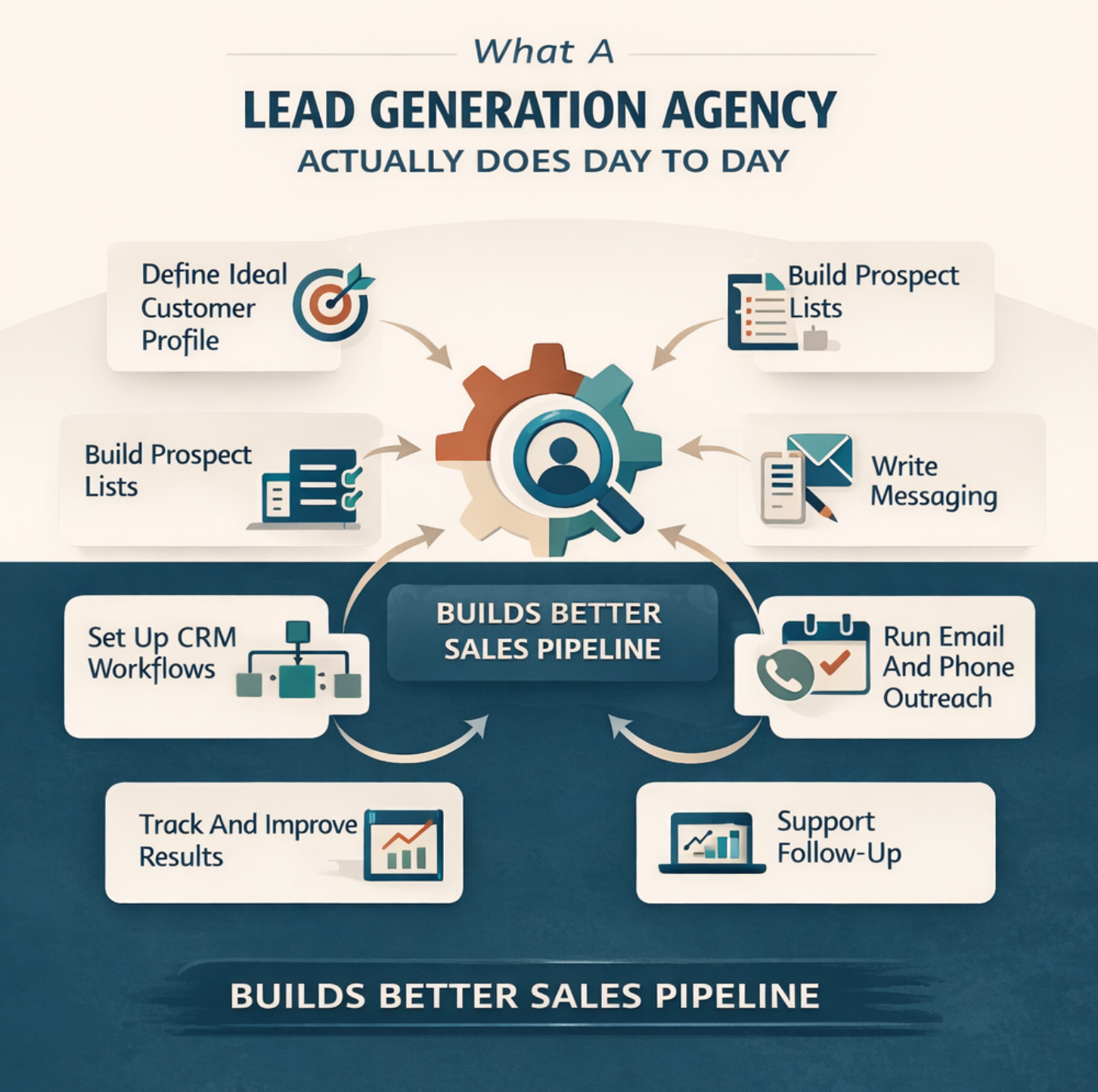
What A Lead Generation Agency Actually Does Day To Day
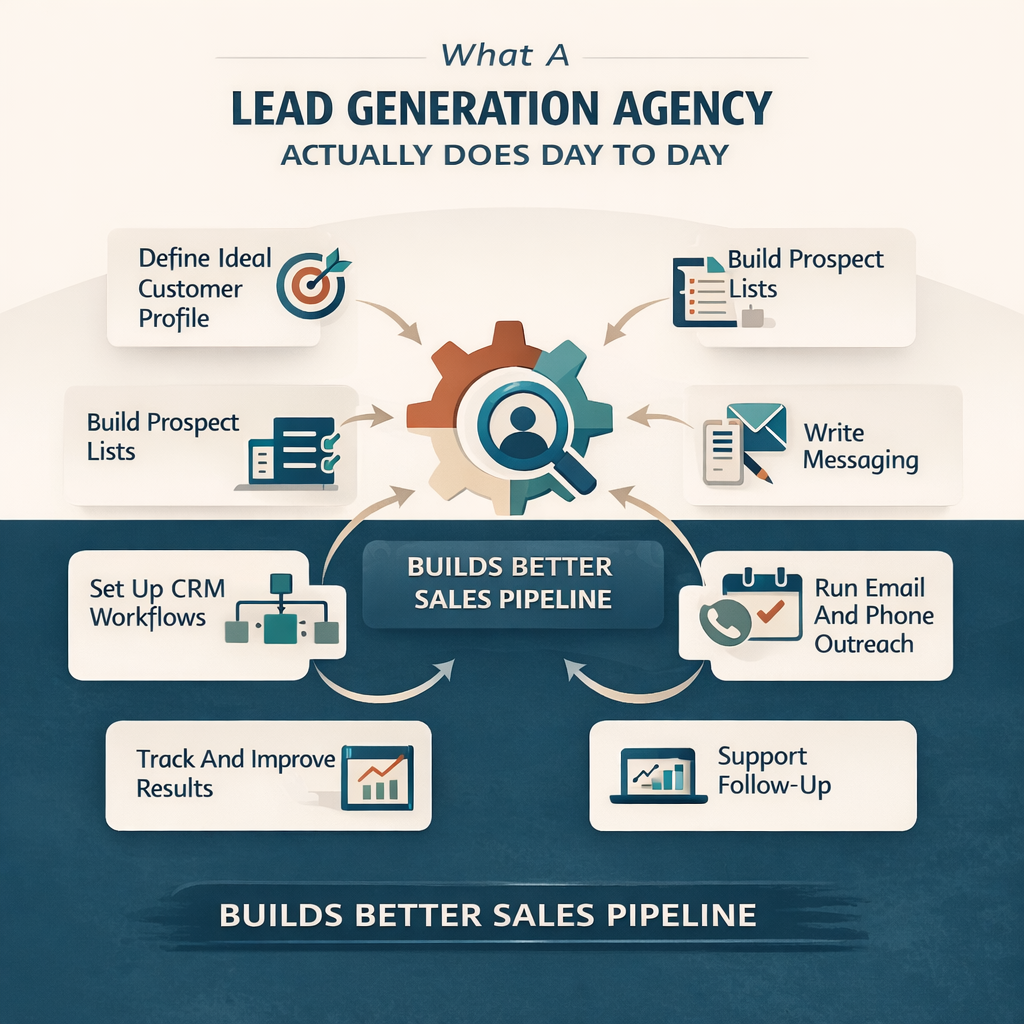
This is the part most articles gloss over. They say agencies “help generate leads,” but they do not explain what that work actually looks like in practice.
For a small business, the real work usually happens across several connected areas.
It Defines Who The Business Should Be Targeting
Before any outreach works, the agency needs clarity on the kind of buyer the business actually wants. That means identifying the ideal customer profile, the types of companies or people that are the best fit, and the problems those buyers are likely trying to solve.
Without that step, lead generation turns into guesswork.
A small business often knows who its best customers are in a general sense, but not always in a structured enough way to build outreach around. A good agency helps turn that intuition into a more usable targeting framework.
It Builds Prospect Lists And Outreach Data
Once the target profile is clear, the next step is building the list of who to go after. That can include companies, owners, operators, decision-makers, job titles, locations, industries, and other traits that shape fit.
This is where the work gets more detailed than many small businesses expect.
A lead generation agency is often doing behind-the-scenes research, list building, filtering, and segmentation so the outreach is pointed at the right people instead of a random batch of contacts.
It Writes Messaging That Opens Conversations
Outreach without good messaging is just noise.
A strong agency writes emails, call scripts, follow-up language, and campaign messaging that fit the business, the offer, and the audience. That messaging should not sound like a copied template. It should sound relevant, specific, and connected to the problem the buyer actually cares about.
This matters because a lot of small businesses think they need more leads when what they really need is better messaging. If the value proposition is weak or unclear, even a strong list will underperform.
It Runs The Outreach Process
This is the most visible part of the work. Depending on the business, that may include cold email, phone outreach, LinkedIn outreach, follow-up sequences, appointment setting, inbound lead handling, or a mix of those channels.
But the important point is not just that the agency is “doing outreach.”
The important point is that it is building a motion. It is trying to create consistent conversations with the right people, not just check a box that activity happened.
It Helps Create Qualified Opportunities
A real lead generation agency should not stop at awareness.
For a small business, the better outcome is usually a qualified conversation, booked meeting, or clearly defined opportunity. In other words, the agency should help move prospects far enough along that the business has something real to work with.
This is one of the biggest differences between low-quality vendors and stronger partners. Weak agencies generate names. Better agencies help generate momentum.
It Supports Follow-Up And Sales Process Structure
This is where a lot of small business growth breaks down.
The leads come in, but the follow-up is inconsistent. The owner is busy. Sales notes live in different places. No one is sure which opportunity is active. Good conversations stall because the process behind them is too loose.
A strong lead generation agency should help tighten this. That may mean setting up better handoff rules, creating clearer follow-up processes, improving CRM structure, or helping the business respond faster and more consistently.
It Tracks Performance And Improves Over Time
Lead generation should not be static.
A good agency watches what is working, what is underperforming, which messages are landing, which audiences are responding, and where leads are dropping off. Then it adjusts.
That ongoing testing is a big part of the value. Small businesses often do not need more complexity. They need someone paying attention closely enough to improve the process over time instead of repeating the same weak motion month after month.
What A Small Business Is Usually Hiring An Agency To Fix
Most small businesses do not wake up one day and decide they want a lead generation agency because it sounds nice. They hire one because something in growth is not working the way it should.
Sometimes the problem is obvious. Sometimes it is buried under a few other symptoms.
Inconsistent Lead Flow
One month is strong. The next month is quiet. The business grows in bursts instead of through something repeatable.
That kind of inconsistency creates stress fast, especially when revenue depends on a small number of deals or conversations. A lead generation agency is often brought in to make pipeline creation less random.
Weak Or Nonexistent Outreach
A lot of small businesses know they should be doing outbound work, but nobody owns it. Or the owner does it occasionally between other priorities. Or someone on the team sends a few emails, but there is no real system behind it.
An agency can step in and build that process more deliberately.
Poor Follow-Up
This is one of the most common hidden issues. The business gets some interest, some calls, some form submissions, maybe even some referrals, but the follow-up is too slow or too inconsistent to turn those opportunities into revenue.
In that situation, the business does not just need more leads. It needs a stronger process for handling the leads it already has.
Too Much Owner-Led Selling
A lot of small business owners become the default sales system without meaning to. They take the calls, respond to leads, follow up when they remember, and keep deals moving through sheer personal effort.
That works for a while, but it does not scale well.
A lead generation agency can help reduce that pressure by building a more structured way to create and manage opportunities.
No CRM Discipline
If the business cannot easily see where leads are, what stage deals are in, or what follow-up is owed, growth becomes much harder to manage.
A good agency may not replace the entire CRM setup, but it should help make the flow of opportunities more visible and usable.
What A Lead Generation Agency Should Not Be Doing?
This part matters because not every provider offering lead generation is actually helping the business grow.
Some are just packaging activity.
A lead generation agency should not be selling a random contact list and calling that pipeline. It should not be blasting generic messages to large numbers of people with no clear targeting. It should not be celebrating vanity metrics while the business sees little actual progress.
It also should not be generating interest without any thought for what happens next.
If the agency sends leads into a weak process and never helps fix the bottleneck, it is only solving part of the problem. That usually leads to frustration on both sides. The agency says it is generating leads. The business says the leads are not turning into revenue. And both are partly right.
This is why the best partners think beyond the first touch.
They understand that lead generation only becomes valuable when the business can capture, qualify, follow up, and move the opportunity forward.
What Small Businesses Often Get Wrong About Hiring One?
Small businesses do not only get let down by bad agencies. Sometimes they also come in with the wrong expectations.
One common mistake is expecting instant deals. An agency can help create opportunity faster, but it is rarely realistic to assume that leads turn into closed revenue immediately, especially if the offer is higher-ticket or the sales cycle has multiple steps.
Another mistake is assuming more leads automatically solve the growth problem.
If the offer is unclear, if the close rate is weak, if follow-up is poor, or if the target audience is off, then more lead flow may just create more visible inefficiency.
Small businesses also sometimes hire an agency before they are ready to support the process. If there is no one available to take meetings, respond quickly, or handle the next stage well, the business will struggle to get the value it wants from the relationship.
The agency can create opportunity, but the business still has to help convert it.
When Hiring A Lead Generation Agency Actually Makes Sense?
A lead generation agency makes the most sense when the business already has something that works, but the growth process around it is too manual, inconsistent, or underbuilt.
That might mean the business has a strong service but no proactive outreach.
It might mean the owner is still carrying too much of the sales burden.
It might mean the company knows who it wants to work with, but lacks the systems, time, or team structure to go after those opportunities consistently.
It might also mean the business is ready to modernize. Not by replacing what works, but by adding more structure, more follow-up discipline, more pipeline visibility, and better execution.
That is usually the sweet spot.
A lead generation agency is often most valuable when the business already has proof of demand, some customer success, and a real offer, but needs help building the engine that supports the next stage of growth.
When A Small Business May Not Be Ready Yet?
Not every business should hire a lead generation agency right away.
If the offer is still unclear, the market is not defined, and the company has no real idea who the right customer is, then the problem is not lead generation first. The problem is strategy and clarity.
If the business has no ability to follow up, no one to take meetings, or no process for moving an opportunity forward, then lead generation will likely feel messy and disappointing.
If the owner is hoping an agency will replace the entire growth function without any internal involvement, that is also a warning sign.
The strongest results usually happen when the business and the agency each own their part well. The agency can help create and support the system, but the business still needs to engage with it.
How Upwind Thinks About Lead Generation For Small Businesses?
At Upwind, we do not think a small business needs more marketing noise.
We think it needs a better sales engine.
That is an important difference. Because small business growth usually does not stall due to one isolated problem. It stalls because targeting, outreach, follow-up, and process are not connected well enough.
A business may need more pipeline, but that pipeline has to come from the right audience. It may need more meetings, but those meetings have to be supported by good messaging and disciplined follow-up. It may need CRM automation, but only in a way that actually helps the team move faster and with more clarity.
That is how we look at lead generation.
Not as a disconnected service that hands over names, but as part of building a more reliable revenue system. For some businesses, that means phone outreach. For others, it means cold email, CRM setup, better follow-up structure, or a mix of those pieces working together.
The point is not to create activity for its own sake.
The point is to help small businesses create more opportunities in a way that can actually support growth.
What A Good Agency Should Help You Measure?
A small business should not judge a lead generation agency only by surface activity.
Dials, sends, and list size can matter, but they are not the main story.
A better agency should help the business understand how many qualified conversations are happening, how many meetings are getting booked, how quickly follow-up is happening, how much pipeline is being created, and where the opportunities are stalling or progressing.
It should also help the business see patterns over time.
Which industries respond best. Which messages create replies. Which parts of the sales process are strong. Which parts are leaking opportunity. That visibility is a big part of the value.
Because the best lead generation work does not just produce motion. It produces insight.
Final Thoughts
So what does a lead generation agency actually do for a small business?
At its best, it helps the business stop relying on scattered effort and start building a more repeatable way to create opportunity.
That means targeting the right buyers. Writing stronger outreach. Running the process consistently. Supporting follow-up. Improving CRM visibility. Tracking what works. Tightening what does not. And helping the business move from random lead flow to a clearer sales engine.
That is a much more useful answer than “they get you leads.”
Because for a small business, leads are only valuable when they fit the business, move through a process, and turn into real revenue opportunities. A strong agency understands that. A weak one usually does not.
And that is what owners should be looking for. Not just more activity, but a partner that helps build the kind of growth system the business can actually use.