
A lot of sales teams spend time improving their call scripts, refining their pitch, and trying to book more conversations. Then they lose momentum in one of the simplest places in the process: the follow-up email after the call. That is a costly mistake. A strong call can still stall if the next step is unclear, the recap is vague, or the prospect leaves the conversation without anything concrete to come back to. The call creates momentum, but the follow-up email is often what protects it.
At Upwind, we do not treat post-call follow-up emails like a nice extra. We treat them like part of sales execution. A well-written email helps confirm alignment, reduce confusion, and make it easier for the opportunity to keep moving. That is why this topic matters more than most people think. The best post-call emails do not just sound professional. They keep the pipeline cleaner, the next steps clearer, and the conversation more likely to turn into real revenue.
What A Post-Call Follow-Up Email Is Really Supposed To Do
Most advice on follow-up emails stays too surface-level. It says to say thank you, summarize the call, and include next steps. That is not wrong, but it misses the bigger point.
A post-call follow-up email is not just a recap. It is a tool for reinforcing the sales process after the conversation ends.
It Confirms What Was Actually Said
Calls move fast. People hear different things, interpret priorities differently, and sometimes leave with different assumptions. A good follow-up email brings the conversation back into focus.
It helps both sides walk away with the same understanding of the pain points, goals, timing, and action items discussed on the call.
It Creates Accountability
One of the biggest reasons deals stall is that nobody clearly owns the next move. The rep thinks the buyer will circle back. The buyer thinks the rep will send something over. Then nothing happens.
A good post-call email removes that ambiguity. It makes the next step visible and gives both sides something specific to work from.
It Keeps Momentum Alive
Momentum is fragile in sales. Even a strong call can cool off quickly if the next touch feels generic or delayed. The follow-up email helps extend the energy of the conversation while it is still fresh.
That matters because buyers are busy. If you do not make it easy for them to re-enter the conversation, the opportunity often drifts.
Why Timing Matters More Than People Realize
A lot of reps know they should send a follow-up email. The bigger issue is when they send it. The timing often says as much about the quality of the sales process as the content itself.
Send It While The Call Is Still Fresh
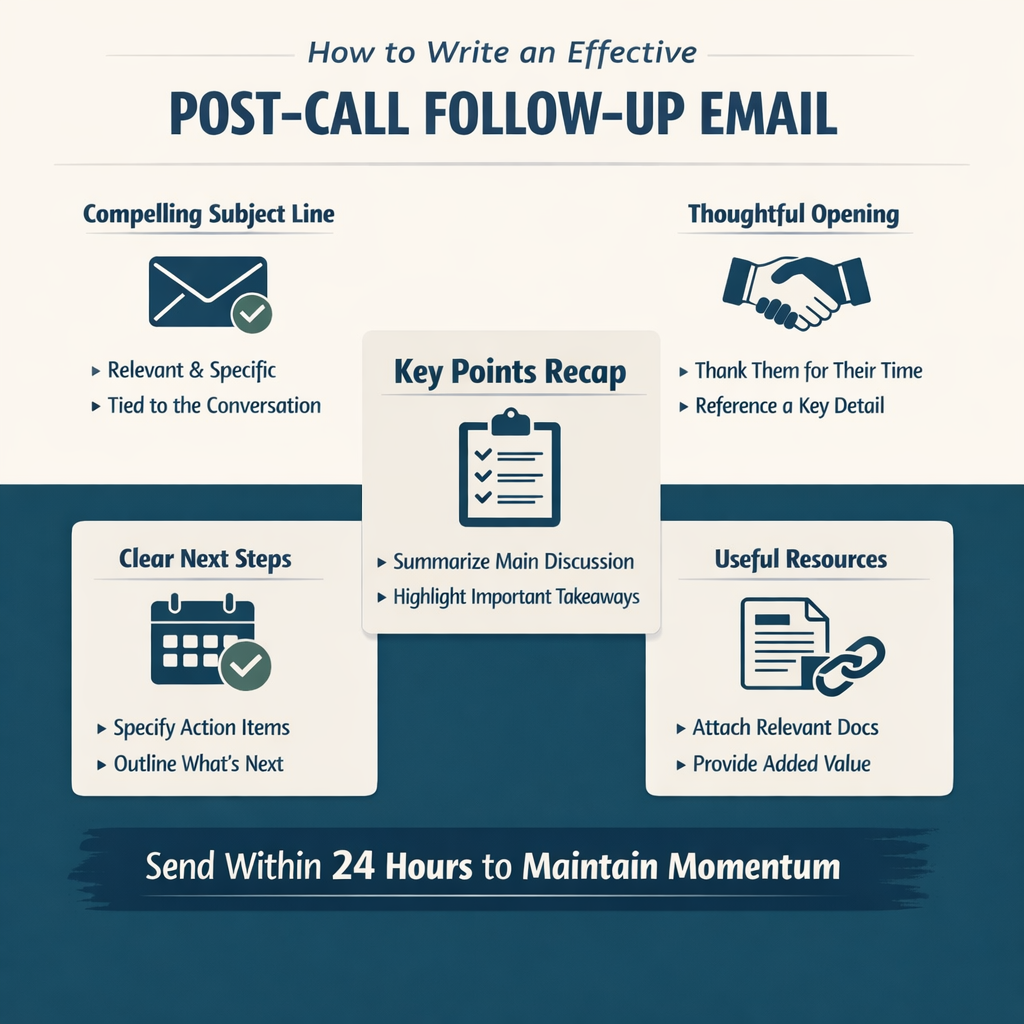
The best time to send a post-call follow-up email is usually the same day or within 24 hours. That keeps the call relevant and shows the prospect that your process is organized.
When the email arrives quickly, it feels connected to the conversation. When it shows up two or three days later, it often feels like an afterthought.
Faster Is Better When The Deal Has Energy
If the call went especially well, or the buyer sounded engaged and ready to move, speed matters even more. The faster you reinforce the discussion, the better your chances of holding that momentum.
This does not mean rushing out a messy email. It means having enough process discipline to follow a good call with a strong next touch while interest is still high.
Delayed Follow-Up Sends A Message
Even if the prospect never says it out loud, a slow follow-up can signal weak process, low urgency, or lack of attention to detail. That is not the impression you want after asking someone to trust your business.
A prompt email tells the buyer that the conversation mattered and that your team knows how to move things forward.
What Every Strong Post-Call Follow-Up Email Should Include
The best post-call emails are not complicated. They are just clear, useful, and intentional. Each part of the email should help the opportunity advance rather than just fill space.
A Subject Line That Makes Sense
The subject line should feel tied to the actual conversation. It should help the recipient recognize the context immediately without sounding generic or overly clever.
A simple subject line often works best. Something tied to the call, the topic, or the next step is usually enough. The goal is clarity, not creativity.
A Brief Thank-You And Personal Opening
The opening should acknowledge the conversation and make the email feel connected to the call that just happened. That might mean thanking them for their time and referencing one specific point from the discussion.
This matters because generic follow-up emails often sound like they could have been sent to anyone. A small amount of specificity makes the message feel more real and more relevant.
A Short Recap Of What Matters Most
This is where a lot of reps either say too little or far too much. The follow-up email should not become a transcript of the call. It should summarize the most important parts of the conversation.
That usually means the key challenge, the goal, the priority, or the need that came up. If the discussion covered a lot of ground, focus on the points that actually affect what happens next.
Clear Next Steps
This is one of the most important parts of the email. The prospect should not have to guess what happens after they finish reading.
Spell out the next step clearly. That could mean sending over a proposal, scheduling a second call, reviewing internal details, or confirming a timeline. If there are responsibilities on both sides, make that obvious too.
Any Promised Materials
If you said you would send something, send it. This could be a proposal, a case study, a pricing document, a link, a calendar invite, or a short summary resource.
The follow-up email is where you prove your process is dependable. If you promised something on the call and it is missing from the email, trust drops fast.
How To Keep The Email Clear Without Making It Too Long
A lot of follow-up emails become bloated because the sender is trying to sound thorough. That usually backfires. The best emails feel focused, not crowded.
Lead With Context
Open the email in a way that reminds the recipient what the conversation was about. This helps the message feel grounded immediately and prevents the email from sounding like a generic sales follow-up.
A simple sentence with thanks and a reference to the call is usually enough.
Summarize Decisions, Not Every Detail
You do not need to repeat every point discussed on the phone. What matters is what came out of the call, not everything said during it.
That means focusing on decisions, priorities, agreed challenges, and next actions. The more selective you are, the easier the email is to scan and act on.
End With One Clear Ask
Many weak follow-up emails lose power at the end. They finish with vague language like “let me know your thoughts” or “happy to connect again anytime.”
That is too open-ended. A stronger ending gives the recipient one clear next move. It might be replying with feedback, confirming a time, reviewing a document, or looping in another stakeholder.
The Best Subject Lines For Post-Call Follow-Up Emails
Subject lines matter because they frame the email before it is even opened. They do not need to be fancy, but they should be clear and tied to the conversation.
Keep It Specific
Specific subject lines usually perform better than broad ones because they sound more connected to a real interaction. They also make it easier for the buyer to find the email again later.
Examples like “Next Steps From Today’s Call” or “Recap From Our Conversation About Hiring” tend to work better than something vague like “Following Up.”
Match The Call Context
The subject line should reflect what the call was actually about. If it was a discovery call, a pricing conversation, or a discussion around a certain pain point, use that context.
The more relevant the subject line feels, the more likely the email feels like a continuation of the conversation instead of a disconnected sales touch.
Avoid Generic Sales Language
Phrases that sound automated or overly promotional usually weaken a post-call email. This is not cold outreach anymore. The person already spoke with you.
Your follow-up should feel like a real continuation of a business conversation, not like the next step in a mass sequence.
How To Write Follow-Up Emails For Different Call Situations
Not every call ends in the same place, so not every follow-up email should sound the same. This is where a lot of teams rely too much on one template.
After A Discovery Call
A discovery call follow-up should usually recap the business problem, the priorities shared on the call, and the next step in the process.
This type of email works best when it shows that you listened carefully. Reflecting the prospect’s goals and challenges in their language helps reinforce fit and understanding.
After A Qualification Call
A qualification call follow-up should confirm the basics that matter most: what the company needs, whether there is likely fit, and what should happen next.
This email should feel efficient. The goal is not to oversell. It is to show structure and make the next move easy.
After A Pricing Or Proposal Call
This kind of follow-up should remove friction. It should confirm the pricing discussion, address any decision criteria that came up, and make the next step as concrete as possible.
At this stage, vague emails are especially risky. The buyer is already weighing the opportunity, so the email should help simplify the path forward.
After A Strong Call With No Clear Next Step
This happens more often than people admit. The call feels positive, but it ends without a defined next move. If that happens, the follow-up email becomes even more important.
In that situation, the email should create structure. Suggest the next step, propose a time, or offer a logical action based on the conversation. Do not leave the deal floating.
Mistakes That Make Post-Call Follow-Up Emails Weaker
Most bad follow-up emails do not fail because the sender forgot to be polite. They fail because the message does not actually help move the deal.
Being Too Generic
A generic email sounds like it could have been sent to anyone. That weakens trust and makes the call feel less meaningful.
Even a short personalized reference can make a big difference. It shows that the email belongs to this conversation, not just to your process.
Writing Too Much
Long follow-up emails often come from good intentions, but they create more friction than value. Most buyers will not read a wall of text after a call.
Keep the email tight. Focus on what matters. The goal is clarity, not completeness.
Leaving The Next Step Unclear
This is one of the most common mistakes. If the recipient does not know what happens next, the opportunity becomes easier to ignore.
A strong follow-up gives the prospect a simple path forward. A weak one leaves them with work to do.
Sending Nothing Useful
The email should do more than say thank you. It should provide something practical, even if that is just a clean recap and next action.
If a call ends and the follow-up adds no clarity, no value, and no momentum, it becomes easy for the buyer to move on.
Why Post-Call Follow-Up Emails Matter At Upwind
At Upwind, we think about follow-up emails the same way we think about every part of the sales process: as leverage. A good system should reduce confusion, create consistency, and help opportunities move forward with less friction.
That is exactly what a strong post-call follow-up email does. It supports the conversation, strengthens accountability, and turns a good call into a cleaner next step.
This also connects directly to how we think about revenue growth. Pipeline is not built only by getting attention. It is built by what happens after attention becomes conversation. A lot of businesses lose opportunities not because they failed to book the call, but because their follow-up process is too loose.
That is why disciplined follow-up matters so much. A post-call email may seem small, but it often reveals whether the company has a real sales engine or just scattered activity.
Simple Post-Call Follow-Up Email Templates
Templates are useful, but only when they support clear thinking. They should guide structure, not replace relevance.
Template After A Discovery Call
Hi [Name],
Thanks again for taking the time to speak today. I appreciated the chance to hear more about your goals around [topic].
From our conversation, it sounds like the biggest priorities right now are [priority one] and [priority two]. You also mentioned that [challenge or timing detail] is an important factor.
As discussed, the next step is [next step]. I’ll [your action], and you’ll [their action] by [timeframe if relevant].
I’ve also included [resource or document] here for reference.
Looking forward to keeping things moving.
Best,
[Your Name]
Template After A Pricing Or Proposal Call
Hi [Name],
Thanks for the conversation today. It was helpful to talk through the scope, priorities, and what success would look like on your side.
To recap, we reviewed [brief recap], discussed [decision factor], and agreed that the next step is [next step].
I’m sending over [proposal, pricing, resource] here so you have everything in one place. Once you’ve had a chance to review it, we can reconnect on [specific day or action].
Let me know if anything needs clarification in the meantime.
Best,
[Your Name]
Template After A Call Without A Clear Next Step
Hi [Name],
Thanks again for taking the time to connect today. I enjoyed the conversation and appreciated the context you shared around [topic].
Based on our discussion, it seems like [problem, goal, or opportunity] is the main focus right now. A logical next step from here would be [suggested next step].
If that makes sense, I’d be happy to [propose next action]. If another direction is better on your side, just let me know.
Best,
[Your Name]
How To Make Your Follow-Up Emails Better Over Time
This is not a one-and-done skill. Like most sales communication, post-call follow-up gets better when the team pays attention to what helps deals move.
Review the emails that tend to lead to replies, second meetings, or faster decisions. Look at what they have in common. Usually it is not flashy writing. It is clarity, relevance, and a strong next step.
It also helps to tighten the connection between call notes and follow-up habits. When reps take stronger notes, their emails improve. When their emails improve, the pipeline gets easier to manage.
This is one of those small process upgrades that can create real downstream results. Better follow-up emails do not just sound sharper. They make the rest of the sales motion stronger.
Final Thoughts
Writing a post-call follow-up email is not about checking a box. It is about helping the opportunity move forward while the conversation is still alive.
The best emails are clear, specific, and useful. They confirm what matters, make the next step obvious, and reinforce that your team knows how to run a process.
That is the real standard. Not sounding polished for the sake of it, but sending an email that keeps the deal organized and easier to advance.
If your team is already putting in the work to get people on the phone, the follow-up should do justice to that effort. Because strong calls create opportunity, but strong follow-up is often what keeps it from slipping away.
FAQs
How Do You Write A Follow-Up Email After A Call?
Start by thanking the person for their time, reference the conversation briefly, summarize the key points, and clearly state the next step. Keep the email concise and focused on moving the conversation forward.
What Should A Post-Call Follow-Up Email Include?
It should include a clear subject line, a short thank-you, a recap of the most important discussion points, any promised resources, and a specific next step or call to action.
How Soon Should You Send A Follow-Up Email After A Phone Call?
In most cases, the best time is the same day or within 24 hours. That keeps the conversation fresh and helps maintain momentum.
How Long Should A Post-Call Follow-Up Email Be?
It should be short enough to scan quickly but detailed enough to clarify the conversation. Most strong follow-up emails are brief and focused rather than long and comprehensive.
What Is A Good Subject Line For A Post-Call Follow-Up Email?
A good subject line is clear and connected to the call. Something like “Next Steps From Today’s Call” or “Recap From Our Conversation About [Topic]” usually works well.
Should You Include Action Items In A Follow-Up Email?
Yes. Action items help create accountability and reduce confusion. They make it clear who is doing what next and help keep the opportunity moving.
What Do You Say In A Follow-Up Email After A Discovery Call?
Thank the prospect, recap the main goals or challenges discussed, confirm the next step, and include any resources you promised. The goal is to show you listened and to make the next move easy.
What If The Prospect Does Not Reply To The Follow-Up Email?
If there is no reply, send another short follow-up that reconnects to the conversation and restates the next step. Keep it professional and specific rather than overly broad or passive.