Most businesses do not ask about inbound and outbound lead generation because they want a marketing definition. They ask because they want more pipeline, better opportunities, and a clearer path to growth.
That is where the conversation usually gets oversimplified. Inbound gets framed as the smart long-term play. Outbound gets framed as the fast but aggressive option. Then the article ends by saying both matter. That is technically true, but it does not help a business owner decide what to do next.

At Upwind, we look at lead generation through a more practical lens. The question is not which channel sounds better. The question is which approach helps your business create opportunities now, build momentum over time, and support a stronger sales engine overall.
For some companies, inbound is the right foundation because buyers are already searching for solutions and trust matters before a sales conversation happens. For others, outbound is the better lever because waiting for prospects to show up is too slow and too unpredictable.
And for many growing businesses, the real answer is not choosing one side. It is understanding what each one does best and making them work together.

What Inbound And Outbound Lead Generation Actually Mean
Before comparing them, it helps to define them the right way. A lot of confusion comes from treating inbound and outbound like they are just marketing preferences when they are really different ways of creating demand and conversations.
What Is Inbound Lead Generation?
Inbound lead generation is about attracting prospects toward your business. Instead of reaching out first, you create visibility and credibility that brings buyers to you.
That can happen through SEO, service pages, blog content, guides, webinars, social content, referrals, and other trust-building assets. The key idea is that the prospect discovers you because they are already searching, researching, or comparing options.
Inbound works best when buyers need information before they are ready to talk. It also works well when your business benefits from being found consistently over time rather than relying only on direct outreach.
What Is Outbound Lead Generation?
Outbound lead generation is about proactively going into the market and starting the conversation yourself. Instead of waiting for interest to come to you, you identify the right prospects and reach out directly.
That might include cold calls, cold email, outbound LinkedIn activity, targeted lists, appointment setting, and account-based outreach. The goal is to create opportunities with the people you want to do business with, not just the people who happen to find you.
Outbound is especially useful when you need pipeline faster, want more control over who enters the funnel, or need to break into accounts that are not actively searching for you yet.
The Core Difference Between Inbound And Outbound
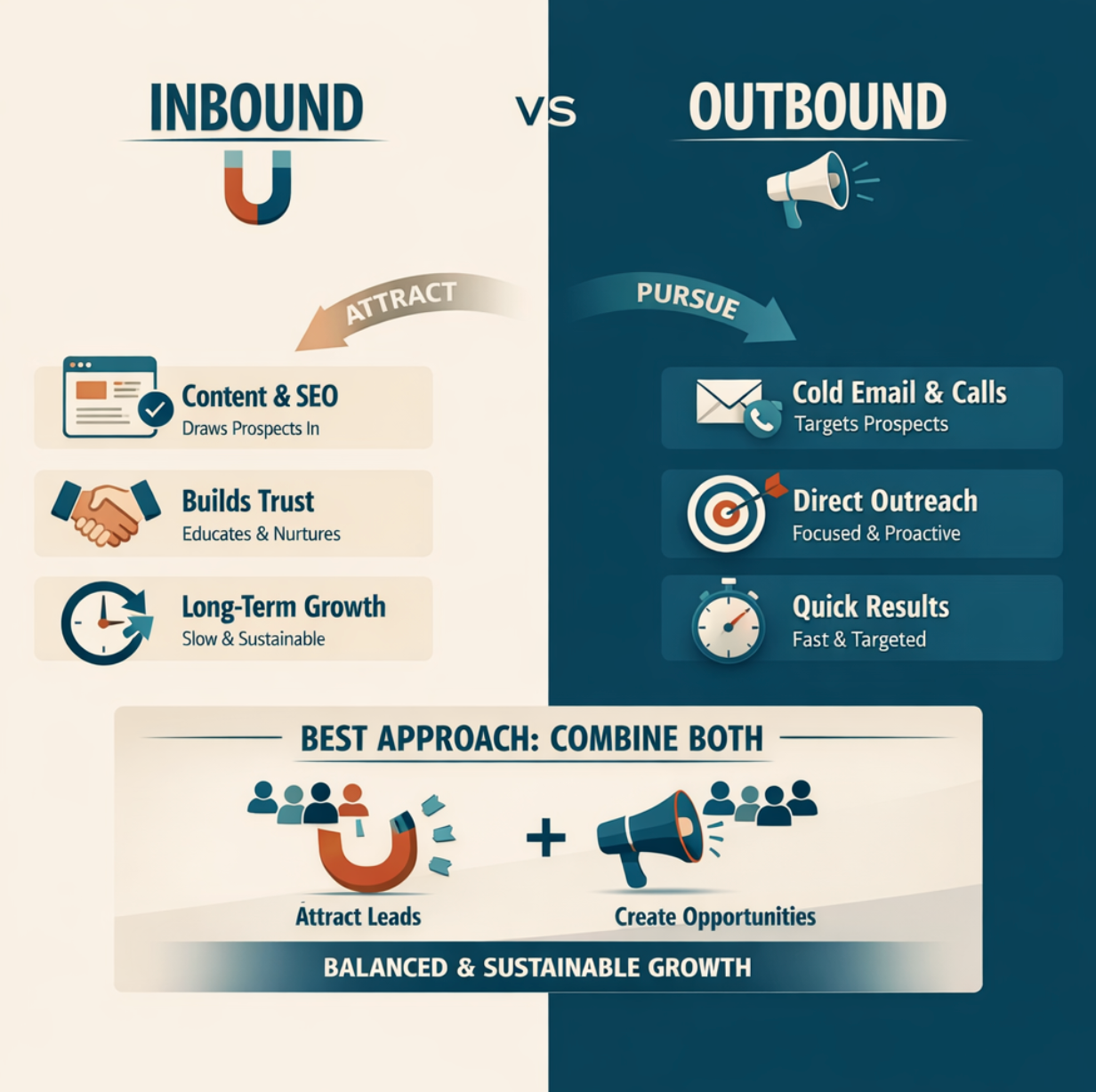
The easiest way to understand the difference is this: inbound attracts attention, while outbound creates attention. Both matter, but they solve different growth problems.
Inbound Pulls Buyers Toward You
Inbound works by building interest and trust before direct contact happens. A prospect lands on your site, reads your content, sees your expertise, and begins to view your business as a credible option.
That makes inbound feel more natural to the buyer. They are not being interrupted. They are finding you because they already have a problem, a question, or a purchase path in motion.
This is one reason inbound leads often feel warmer. They usually arrive with some level of context and intent because they chose to engage.
Outbound Pushes Your Message Into The Market
Outbound works by putting your message in front of the people you want to reach, whether they were looking for you or not. It is more proactive and more targeted.
That makes outbound more direct. You are not waiting to be discovered. You are deciding who matters, building a list, and going after the opportunity.
This approach can be incredibly effective, especially for B2B companies with a clear ideal customer profile. When you know who you want to reach, outbound gives you a way to start the conversation sooner.
One Compounds, One Accelerates
Inbound usually compounds over time. Strong pages, useful content, and better search visibility can keep generating leads long after they are created.
Outbound usually accelerates faster. A solid outreach motion can create meetings, feedback, and pipeline in a much shorter timeframe.
That is why this is not really a battle between good and bad. It is a trade-off between compounding and acceleration, between discovery and control, and between long-term visibility and direct pipeline creation.
The Strengths And Weaknesses Of Inbound Lead Generation
Inbound has real advantages, but it is often romanticized by businesses that underestimate how much work it takes to build. It can be powerful, but it is not automatic.
Why Inbound Can Be So Effective
One of the biggest strengths of inbound is trust. When someone finds your business through search or content, they usually arrive with a problem they already want to solve. That changes the dynamic.
Instead of forcing attention, you are showing up at the moment attention already exists. That often leads to better engagement, stronger fit, and more productive early-stage conversations.
Inbound can also become more efficient over time. A well-built content library, strong service pages, and good search visibility can keep producing leads without requiring a fresh outbound push every single week.
There is also a brand advantage. Inbound helps businesses look established, informed, and credible. For buyers who research heavily before engaging, that matters a lot.
Where Inbound Falls Short
The biggest challenge with inbound is speed. It usually takes time to build visibility, earn rankings, improve conversion, and create consistent lead flow.
That delay creates frustration for businesses that need opportunities now. If the sales team is light on pipeline, the owner is stretched thin, or revenue pressure is immediate, inbound alone often feels too slow.
Inbound also depends on consistency. Publishing random content, ignoring conversion pathways, or treating SEO like a one-time task usually leads to weak results. The businesses that win with inbound are usually the ones that keep showing up and improving over time.
And finally, inbound only captures the demand that is already moving. It does not necessarily create enough opportunities inside the specific accounts or buyer groups you want most.
The Strengths And Weaknesses Of Outbound Lead Generation
Outbound is sometimes treated like the less sophisticated option, but that usually comes from seeing poor execution. When outbound is done well, it can be one of the clearest ways to create pipeline on purpose.
Why Outbound Can Be So Effective
The biggest strength of outbound is control. You choose the accounts, the buyers, the message, and the timing. That makes it much easier to target the exact kinds of opportunities you want.
Outbound is also faster. A strong cold calling or cold email motion can create conversations, meetings, and feedback far sooner than waiting for inbound visibility to mature.
That speed matters for businesses that are growing aggressively, entering new markets, recovering from weak lead flow, or trying to make sales activity more predictable.
Outbound also creates market signal. You find out quickly whether the offer resonates, whether the audience is right, and where objections show up. That kind of feedback can sharpen the entire sales engine.
Where Outbound Falls Short
The main weakness of outbound is that it requires stronger execution. Bad targeting, weak messaging, poor follow-up, or inconsistent activity can make outbound feel expensive and frustrating.
It also tends to be more effort-heavy. Outbound does not compound in quite the same passive way inbound can. It needs people, systems, management, and ongoing discipline.
There is also more resistance built into the channel. Buyers may ignore your emails, skip your calls, or push back because they were not actively searching at the time of contact. That means outbound must be more intentional to work.
Done poorly, outbound becomes noise. Done well, it becomes one of the most reliable tools a company has for filling the pipeline.
When Inbound Lead Generation Makes More Sense
The right lead generation strategy depends on your situation. Inbound is often the better choice when the business can afford to build gradually and when trust plays a major role in the sales process.
When Buyers Need Education Before They Buy
Some buyers do not want to speak to sales early. They want to read, compare, understand the problem, and get clarity before they ever fill out a form or answer a call.
In those cases, inbound gives them a way to move at their own pace while still engaging with your expertise. That makes content, service pages, and SEO especially important.
When You Want Long-Term Visibility
If your business wants to create a steady stream of discovery over time, inbound is hard to ignore. Good search visibility can keep your company in front of the market long after the initial work is done.
That does not mean it becomes effortless, but it does mean the value can compound. A strong inbound system keeps making the business easier to find.
When Brand Credibility Matters Early
Some businesses sell solutions that require trust before the first conversation. If the buyer checks your website, reads your content, and forms an opinion before replying, inbound helps shape that impression.
That can improve conversion across the whole funnel, not just for organic leads. Even outbound performs better when inbound credibility exists behind it.
When Outbound Lead Generation Makes More Sense
Outbound tends to make more sense when the business needs traction faster or wants more say over who enters the pipeline. It is often the better move when waiting is not a strategy.
When You Need Pipeline Sooner
If your business has weak lead flow today, the sales team cannot wait six months for rankings to improve. Outbound creates a way to start building conversations much faster.
That does not mean abandoning inbound. It means recognizing that speed matters, and outbound is often the most direct way to create near-term movement.
When You Want To Reach Specific Accounts
Inbound brings in who it brings in. Outbound lets you define the account list. That difference is huge for B2B companies with a clear target market.
If there are certain industries, geographies, company sizes, or decision-makers you want, outbound gives you a way to pursue them directly instead of hoping they discover you.
When The Market Is Not Searching Yet
Some excellent businesses operate in markets where the problem is real, but the search demand is weak, fragmented, or not urgent enough to drive strong inbound volume.
In that environment, outbound often carries more weight because the business must create conversations before the market creates them on its own.
Which Leads Are Better: Inbound Or Outbound?
This is one of the most common questions, and it often gets answered too simply. Inbound leads are often described as higher quality, while outbound leads are treated like they are more forced. That is only partly true.
Why Inbound Leads Often Feel Warmer
Inbound leads usually arrive with more context. They found you, consumed something, and made a choice to engage. That often means less resistance in the early conversation.
There is usually some trust already built. The buyer may know your service, understand your positioning, or have already self-qualified to some degree.
Why Outbound Leads Can Still Be Highly Valuable
Outbound leads may start colder, but that does not make them lower value. In many cases, some of the best accounts come from outbound because they match the ideal customer profile perfectly.
They may not have been actively looking, but they still have the problem, the budget, and the need. Outbound simply starts the conversation earlier.
Lead Quality Depends On System Quality
The real truth is that lead quality depends less on channel and more on fit, targeting, messaging, and follow-up. Great inbound with poor qualification can still create bad leads. Great outbound with sharp targeting can create excellent ones.
That is why businesses should stop treating source as the only signal of quality. The better question is whether the lead matches the business and whether the sales process knows what to do next.
How Inbound And Outbound Work Best Together
This is where the conversation gets more useful. The best businesses do not think in silos. They build systems where inbound and outbound support each other.
Inbound Makes Outbound Stronger
When a prospect receives an email or a call, one of the first things they may do is check the website. If what they find feels weak, generic, or outdated, the outbound touch loses force.
Strong inbound assets make outbound more credible. Good pages, useful articles, and clear positioning help validate the outreach and reduce friction.
Outbound Makes Inbound Less Passive
Inbound alone can become too dependent on timing. You may have a great website and strong content, but still be limited by how many people happen to find you.
Outbound adds control. It lets the business pursue the accounts it wants instead of waiting entirely on discovery. That makes the growth model more balanced.
Both Create A Better Sales Engine
Inbound can attract interest. Outbound can accelerate conversations. Inbound can support follow-up. Outbound can surface objections and sharpen messaging. Together, they help the company build a sales engine instead of a scattered collection of tactics.
That is the point. Not more activity for the sake of it, but a better system for creating predictable opportunities.
How Upwind Thinks About Inbound And Outbound Lead Generation
Upwind does not look at lead generation as a debate between marketing and sales. We look at it as part of the larger revenue machine.
For businesses that need long-term visibility, stronger positioning, and better trust signals, inbound matters. It helps the right people find you and gives them a reason to take you seriously.
For businesses that need momentum, targeted conversations, and faster feedback from the market, outbound matters. It helps create activity around the accounts that matter most instead of waiting for opportunity to appear randomly.
That is why we do not reduce growth to one tactic. A strong business usually needs both. It needs a way to attract demand and a way to create it. It needs credibility in the market and proactive movement in the pipeline.
Most importantly, it needs those things connected. When inbound and outbound operate separately, the business gets fragmented results. When they support the same sales process, the growth system becomes much more reliable.
How To Decide Where To Invest First
The smartest place to start is not with a universal rule. It is with your current business reality.
Start With Inbound First If
Your market already searches for solutions like yours. Your business benefits from trust and education before the sale. You want long-term visibility that compounds. And you can afford to build patiently.
In that case, inbound can become a strong foundation. It gives the company discoverability, credibility, and a durable asset base that supports future growth.
Start With Outbound First If
You need more pipeline now. You know your ideal customer profile. You want to reach specific accounts. Or your market is not generating enough search-driven demand on its own.
In that case, outbound often makes more sense as the first lever. It creates direct movement and helps the business take control of opportunity creation.
Build Both If You Want Stability
The most resilient growth systems usually do both. Inbound supports trust and discovery. Outbound supports speed and precision. Together, they reduce the risk of depending too heavily on one channel.
That kind of balance matters because markets shift. Search patterns change. Outreach performance changes. A business with more than one engine tends to be more stable.
Common Lead Generation Mistakes Businesses Make
The biggest lead generation failures usually do not come from choosing inbound or outbound. They come from poor execution after the choice is made.
One common mistake is expecting inbound to work too quickly. Businesses publish a few blogs, make a few page updates, and then assume the strategy failed when lead flow does not transform overnight.
Another mistake is treating outbound like a pure numbers game. More dials and more sends do not automatically mean more opportunities. Without targeting and relevance, volume just creates more waste.
A third mistake is generating leads without building the follow-up system behind them. Businesses invest in attracting or creating leads, then lose momentum because the CRM is weak, handoff is messy, or no one is owning the process.
And finally, many teams track the wrong things. Traffic, opens, reply rates, and call counts can all be useful, but they are not the finish line. The real measure is whether the system creates qualified opportunities, sales momentum, and revenue growth.
The Real Answer: Growth Needs Both Pull And Push
Inbound and outbound lead generation are not opposites. They are different tools for different jobs.
Inbound is powerful because it builds trust, visibility, and long-term lead flow. Outbound is powerful because it creates movement, control, and targeted opportunity creation. Neither one is enough to explain growth on its own.
The businesses that win usually understand this earlier than everyone else. They stop looking for a perfect channel and start building a better sales engine. They use inbound to make the company easier to find and easier to trust. They use outbound to make the pipeline more deliberate and less dependent on chance.
That is the real comparison worth making. Not which one sounds smarter, but which mix helps the business grow in a more predictable way.
FAQs
What Is The Difference Between Inbound And Outbound Lead Generation?
Inbound lead generation attracts prospects through channels like SEO, content, and website visibility. Outbound lead generation reaches out directly through channels like cold calling, cold email, and targeted prospecting.
Which Is Better: Inbound Or Outbound Lead Generation?
Neither is universally better. Inbound is usually better for long-term trust and discoverability. Outbound is usually better for speed, targeting, and proactive pipeline creation.
Are Inbound Leads Higher Quality Than Outbound Leads?
Sometimes, but not always. Inbound leads often feel warmer because they found you first. Outbound leads can still be high quality when targeting is strong and the offer matches the right buyer.
Is Outbound Lead Generation Faster Than Inbound?
Yes, in most cases outbound creates faster opportunities because it does not rely on being discovered first. Inbound usually takes longer to build momentum but can become more efficient over time.
Can Small Businesses Use Both Inbound And Outbound?
Yes. In fact, many small businesses benefit from using both. Inbound helps build credibility and visibility, while outbound helps create conversations and pipeline faster.
When Should A Business Focus On Inbound First?
A business should focus on inbound first when buyers research heavily before making a decision, when long-term search visibility matters, and when the company can invest patiently in growth.
When Should A Business Focus On Outbound First?
A business should focus on outbound first when it needs pipeline quickly, wants to reach specific accounts, or operates in a market where buyers are not actively searching enough to support strong inbound lead flow.
How Do Inbound And Outbound Work Together?
Inbound builds authority, trust, and visibility. Outbound creates direct conversations and targeted pipeline. Together, they help a business attract demand and create demand at the same time.