When a business wants more pipeline, one of the first outbound questions is usually simple on the surface and more complicated in practice: should you focus on cold calling or cold email?
A lot of teams treat this like a debate where one channel has to win. In reality, that is usually the wrong way to think about it. The better question is which channel fits your offer, your buyer, your sales cycle, and your goals.
For some businesses, cold email is the easiest way to reach a larger audience and test messaging quickly. For others, cold calling creates better conversations, faster feedback, and more qualified meetings. And for many companies, the best results come from using both in a coordinated way.
At Upwind, we look at outbound through a practical lens. The goal is not to sound modern or old school. The goal is to create conversations, build pipeline, and give the sales team a more reliable engine. That means choosing the channel based on what actually moves revenue forward.
What Cold Calling And Cold Email Actually Do Best
Both channels can create opportunities, but they do not do the same job in the same way. That is where many businesses get stuck. They compare activity types without understanding how each one performs inside a real sales process.
Cold email works best when you need scale, flexibility, and a lower-cost way to open doors. It lets you reach more prospects, test messaging, and stay present in a buyer’s inbox without requiring a live interaction.
Cold calling works best when timing matters, when the offer is more complex, or when you need to qualify interest quickly. A call creates a real conversation. You hear objections, you test positioning, and you find out faster whether the account is worth pursuing.
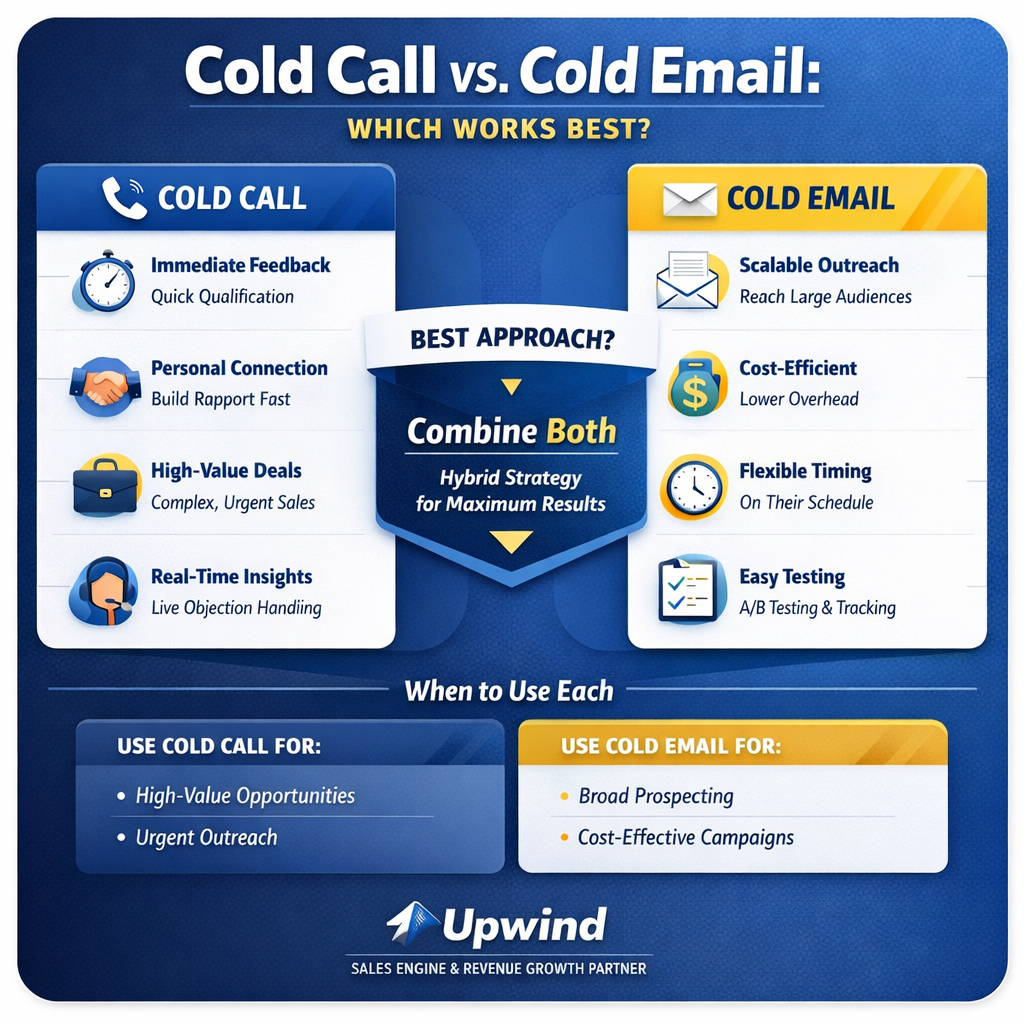
That difference matters. Email gives you reach. Calling gives you signal. Both can be valuable, but they solve different outbound problems.
The Core Differences Between Cold Calling And Cold Email
The gap between these channels is not just about preference. It is about how buyers engage and how sales teams create momentum.
Speed Of Feedback
Cold calling gives immediate feedback. You know right away whether your opening works, whether the prospect has interest, and whether your pitch needs adjustment. That kind of live market signal is hard to replace.
Cold email moves slower. You may wait hours or days for a response, and in many cases you get no response at all. That does not make email ineffective, but it does mean the feedback loop is less direct.
Scale And Efficiency
Cold email is easier to scale. A team can reach many more prospects in less time, segment by persona, and run tests across messaging angles with less manual effort.
Cold calling is more time-intensive. It requires stronger execution, more rep focus, and more persistence. But each live conversation can carry more weight than an unopened email sitting in an inbox.
Rapport And Personal Connection
A phone conversation creates tone, energy, and back-and-forth. That matters in B2B sales, especially when the offer is high value or the buyer is skeptical. Rapport is often built faster in a live call than in a written message.
Email can still feel personal when done well, but it is naturally more distant. It works best when the goal is to create awareness, introduce relevance, or earn the next step rather than close the gap in one touch.
Cost And Operational Demands
Cold email is usually less expensive to run at scale. It requires systems, list quality, and good copy, but it does not demand the same real-time effort as live calling.
Cold calling requires trained people, structure, scripts that do not sound scripted, and management discipline. It is heavier operationally, but it often creates better data and stronger conversations.
When Cold Calling Wins
Cold calling is often dismissed by teams that associate it with outdated scripts and low-quality outreach. That is a mistake. When done well, it remains one of the most effective ways to create qualified conversations.
High-Value And Complex Offers
If your offer is expensive, nuanced, or tied to business operations, cold calling usually has the edge. Complex offers often create questions, objections, and hesitation that are easier to address in real time than over email.
A live conversation lets the rep frame the problem, ask follow-up questions, and adapt based on what the prospect says. That makes calling especially useful for service businesses, operational consulting, and B2B solutions with longer sales cycles.
Urgent Or Time-Sensitive Outreach
When speed matters, calling is hard to beat. If a team wants quick qualification or needs to know whether an account is worth pursuing now, a call compresses the timeline.
Email is passive by comparison. It waits for the prospect to notice, open, and decide to respond. A phone call may not always connect, but when it does, it moves faster.
Faster Qualification
One of the biggest advantages of phone outreach is how quickly it exposes reality. You find out whether the contact is the right person, whether the timing is off, whether budget exists, and whether there is a real problem to solve.
That is valuable because pipeline quality matters more than activity volume. A short conversation can save days of unnecessary follow-up.
When Cold Email Wins
Cold email remains a strong outbound channel when used with discipline. It is especially useful for creating top-of-funnel coverage without overloading the team.
Broad Prospecting At Scale
If you need to reach many accounts, test multiple angles, or introduce the brand to a wide market, email is usually the more practical starting point. It allows a small team to cover more ground and generate early interest signals.
For businesses still refining message-market fit, email can also be a useful testing channel. You can compare subject lines, hooks, and positioning faster than you can in a call-heavy motion.
Flexible Buyer Experience
A lot of decision-makers do not want to be interrupted. They prefer to read on their own time, scan for relevance, and decide whether to engage. Email works well in those cases because it fits around the buyer’s schedule.
That makes it useful when the initial goal is not immediate conversation, but simply a credible first touch that earns attention.
Better Support For Multi-Touch Outreach
Email also helps with consistency. It gives prospects something to revisit, forward internally, or respond to later. In B2B sales, that matters because decision-making is rarely linear.
A good email can stay in circulation longer than a missed call. It can support later touches and help keep the account warm even when no response comes right away.
Should You Email Or Call First?
This is where the conversation gets more strategic. The right sequence depends on what you sell and who you are targeting.
If the prospect list is broad and the goal is awareness, email first often makes sense. It is less disruptive, easier to scale, and useful for testing relevance before investing rep time in live calls.
If the account list is highly targeted and the offer is valuable, calling first can be stronger. A call can reach the truth faster. You find out whether the account is worth pursuing and whether there is immediate interest.
In many cases, the strongest answer is not email first or call first as a rule. It is sequence first. One touch creates awareness, another creates engagement, and another drives action. The channel should match the job.
The Best Outbound Strategy Is Usually A Hybrid
Most serious outbound programs eventually land here. Not because it sounds balanced, but because different channels do different work.
A cold email can introduce relevance and create familiarity. A follow-up call can turn that familiarity into a conversation. Another email can reinforce the value proposition, share context, and keep momentum going.
That sequence often works better than relying on one channel alone. It also creates multiple chances for the prospect to engage in the way that suits them best.
The mistake is treating hybrid outreach like random activity. It should be structured. The messaging should be aligned across channels. The timing should make sense. And the team should know what outcome each touch is designed to produce.
How To Decide Which Channel To Prioritize
The easiest way to choose is to stop asking which channel is better in general and start asking which one is better for your current sales reality.
If Your Offer Is High Ticket
Lean more heavily toward calls. High-value sales usually benefit from live conversation, stronger qualification, and faster objection handling. The more money or operational risk involved, the more valuable direct interaction becomes.
If You Need More Scale
Lean more heavily toward email. It is the faster way to cover market territory, test offers, and open more doors without building a call-heavy system from day one.
If Your Sales Cycle Is Complex
Use both. Complex sales usually need layered communication. One channel starts the process, another deepens it, and both help keep the deal moving.
If Your Team Is Small
Pick one clear motion first. Many teams fail because they try to do everything at once. It is better to run one disciplined outbound system than two messy ones.
Why Upwind Leads With Phone Outreach For High-Intent Conversations
Upwind does not see outbound as a volume game. We see it as part of a larger sales engine. That means the goal is not just more touches. The goal is more qualified opportunities and better pipeline flow.
That is one reason phone outreach remains such an important part of our approach. A strong call strategy creates real conversations, faster signal, and clearer qualification. It helps businesses understand what buyers are actually saying instead of guessing from surface-level metrics.
For companies selling services, solving real business problems, or targeting valuable accounts, that matters. A phone conversation can uncover urgency, pain points, and buying intent in a way email often cannot.
That does not mean cold email has no place. It absolutely does. Email can support awareness, follow-up, and multichannel sequencing. But when a business needs momentum, clarity, and live feedback, phone outreach often becomes the stronger lever.
Mistakes Teams Make With Cold Calling And Cold Email
Most outbound problems do not come from choosing the wrong channel. They come from weak execution inside the chosen channel.
One common mistake is confusing volume with strategy. More emails and more dials do not automatically create pipeline. Without targeting, relevance, and follow-up discipline, activity just becomes noise.
Another mistake is using the same message everywhere. A phone opener should not sound like an email. An email should not read like a voicemail transcript. Each channel needs its own structure while still supporting the same core positioning.
Teams also fail when they stop too early. Most outbound does not work on the first touch. Consistent, thoughtful follow-up usually matters more than the first attempt itself.
And finally, many businesses measure the wrong things. Open rates, dial counts, and send volumes are useful activity metrics, but they are not the end goal. The real question is whether outreach is creating conversations, meetings, pipeline, and revenue opportunities.
The Real Answer: It Depends On The Job
Cold email is not the modern replacement for cold calling. Cold calling is not the universally superior old-school tactic. Both can work. Both can fail. The difference usually comes down to fit and execution.
If you need reach, flexibility, and a scalable way to test messaging, cold email is often the better place to start. If you need real conversations, quick qualification, and stronger movement on high-value opportunities, cold calling often pulls ahead.
For many B2B teams, the best answer is to stop treating this like a binary choice. Build the outbound system around the deal, the buyer, and the sales motion. Then let each channel do the work it is best suited to do.
That is how businesses move beyond scattered activity and start building a real sales engine.
FAQs
Is Cold Calling Better Than Cold Email?
Not universally. Cold calling is usually better for urgency, qualification, and higher-value conversations. Cold email is usually better for scale, testing, and low-friction first touches.
Should You Cold Email Before Calling?
Sometimes, yes. If the goal is to introduce the brand and create light familiarity, email first can work well. But for highly targeted outreach or more valuable offers, calling first can produce faster results.
Is Cold Email More Cost-Effective Than Cold Calling?
In most cases, yes. Email is generally easier and cheaper to scale. But lower cost does not always mean better outcomes, especially if the offer requires live conversation to convert interest.
When Does Cold Calling Work Best?
Cold calling works best when the offer is complex, high-ticket, urgent, or easier to explain through direct conversation. It is also strong when fast qualification matters.
Can Cold Calling And Cold Email Work Together?
Yes, and often they should. Email can create awareness and context. Calls can build momentum and qualify interest. Together, they usually create a stronger outbound system than either channel alone.
Which Is Better For Small Business Owners Selling Services?
It depends on the service and sales cycle, but many service businesses benefit from calling because it creates faster conversations and clearer qualification. Email still plays a useful support role, especially in follow-up and account nurturing.