


Sales emails are easy to send and easy to ignore. Every buyer has an inbox full of pitches, reminders, newsletters, meeting requests, and automated follow-ups competing for the same few seconds of attention.
That is why strong sales email templates matter. They give your team a clear starting point, but they should never replace relevance, timing, and real personalization. A good template helps you move faster without sounding generic.
The goal is not to copy and paste your way into someone’s calendar. The goal is to create better conversations, support the sales process, and make the next step easier for the buyer to take.
Upwind sees sales emails as part of a larger revenue engine. The best emails work alongside phone outreach, CRM follow-up, discovery calls, proposal tracking, and clean handoffs. When the system is connected, every email has a job.
What Makes A Good Sales Email Template?
A good sales email template gives structure without making the message feel stiff. It helps the sender explain why they are reaching out, why it matters, and what the recipient should do next.
The best templates are clear, short, and easy to personalize. They do not try to say everything in one message. They create enough interest for a reply, a call, or a next step.
A Clear Reason For Reaching Out
The recipient should understand why you are emailing them specifically. That reason might be their role, company growth, recent hiring, a market shift, a public announcement, or a clear problem your team helps solve.
Without a relevant reason, the email feels like a mass blast. With one, the email feels connected to the buyer’s world.
A Simple Value Message
Your email should quickly answer the buyer’s real question: why should I care? That does not mean writing a long pitch. It means connecting your offer to a problem, result, or opportunity that matters to them.
The value message should be specific enough to feel useful and simple enough to understand quickly.
One Clear Call To Action
Strong sales emails make the next step obvious. A vague ending like “let me know your thoughts” puts too much work on the buyer.
Use one clear ask. That might be a 10-minute call, a quick reply, a referral to the right person, or permission to send more context.
Sales Email Anatomy: What Every Strong Email Needs
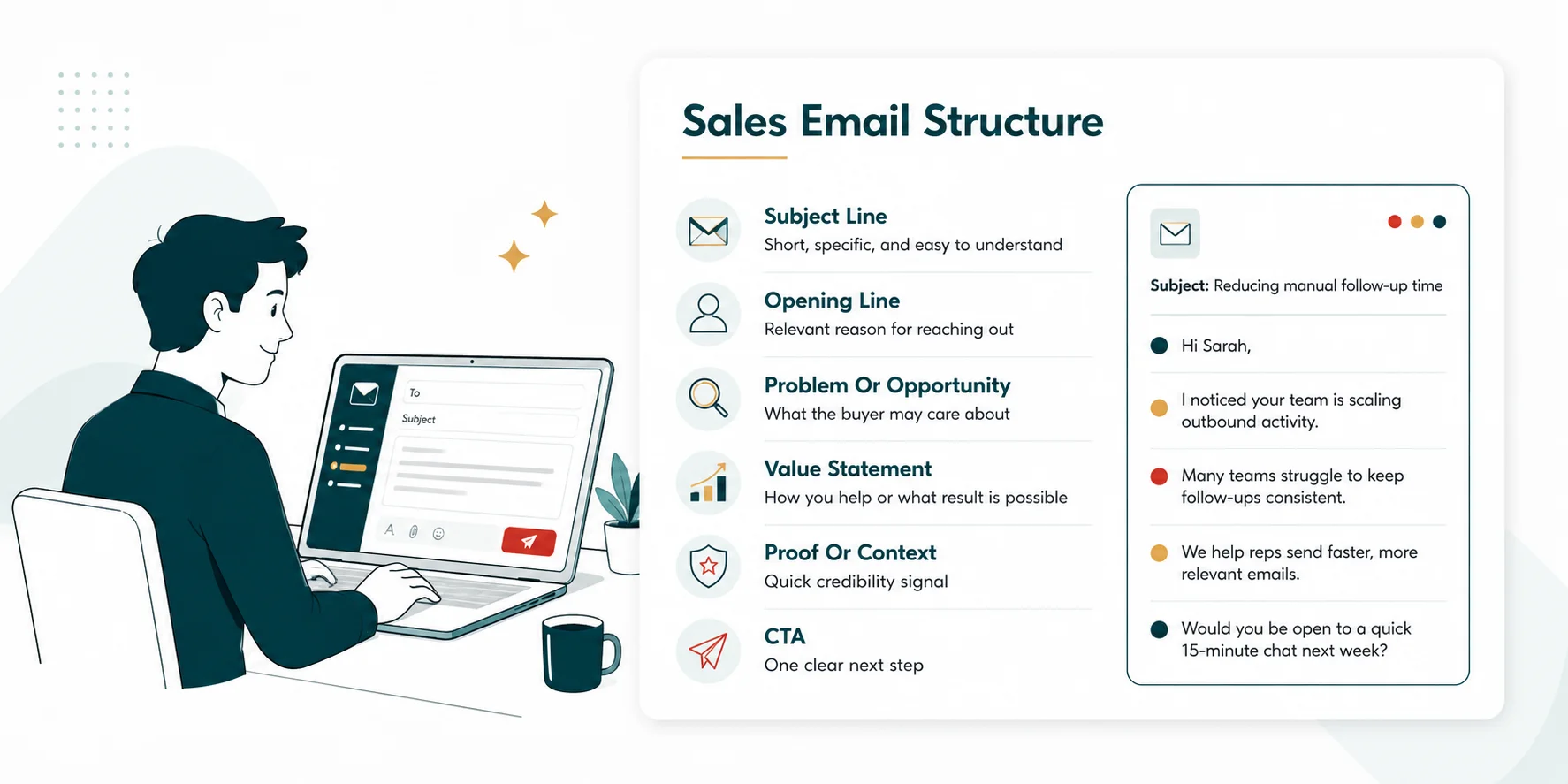
Before the templates, it helps to understand the building blocks. A sales email works best when every line has a purpose.
Think of the email as a small sales system. The subject line earns the open, the first line earns attention, the body creates relevance, and the CTA moves the buyer toward action.
The Sales Email Structure
A strong sales email usually includes:
- Subject Line: Short, specific, and easy to understand
- Opening Line: A relevant reason for the message
- Problem Or Opportunity: What the buyer may care about
- Value Statement: How you help or what result is possible
- Proof Or Context: A quick credibility signal when useful
- CTA: One clear next step
This structure keeps the email focused. It also gives your team a repeatable framework they can adapt across different sales situations.
Cold Prospecting Sales Email Templates
Cold prospecting emails need relevance fast. The buyer has not asked to hear from you, so the email must earn attention without overexplaining.
The best cold emails sound specific, useful, and low-pressure. They open the door to a conversation instead of trying to force the whole sale in one message.
Template 1: The Problem-Aware Cold Email
Subject: Quick Question About [Business Area]
Hi [First Name],
I noticed [Company] is focused on [specific area, growth goal, or market]. One issue we often see at this stage is that sales activity increases, but follow-up and pipeline visibility do not keep pace.
Upwind helps teams build cleaner outbound and follow-up systems so more opportunities move from first touch to real conversation.
Is improving pipeline consistency a priority for your team right now?
Best,
[Your Name]
This works because it connects to a business problem rather than opening with a long introduction. The CTA is simple and easy to answer.
Template 2: The Trigger Event Email
Subject: Congrats On [Trigger Event]
Hi [First Name],
I saw that [Company] recently [hired, expanded, launched, raised, opened a location, announced a new initiative]. That kind of growth often creates more pressure on sales follow-up, lead handling, and pipeline management.
Upwind helps companies tighten the sales engine behind that growth, including outreach, CRM workflows, and follow-up systems.
Would it be useful to compare notes on where new opportunities may be getting missed?
Best,
[Your Name]
This template works well when there is a real business reason for outreach. The trigger gives the email context and makes it feel more timely.
Template 3: The Quick Question Email
Subject: Quick Question
Hi [First Name],
Are you the right person to ask about how [Company] handles outbound sales and lead follow-up?
I’m reaching out because Upwind helps businesses create more consistent sales opportunities through phone outreach, CRM automation, and better follow-up systems.
If this sits with someone else, would you be open to pointing me in the right direction?
Best,
[Your Name]
This works because it does not assume too much. It is useful when the contact may not be the final decision-maker.
Template 4: The Industry Insight Email
Subject: Idea For [Company]
Hi [First Name],
A lot of companies in [industry] are trying to grow sales without adding more chaos to the team. The challenge is usually not effort. It is follow-up, visibility, and consistency across the pipeline.
Upwind helps teams turn scattered outreach into a more structured sales process, especially when phone outreach and CRM follow-up need to work together.
Would it be worth a quick conversation to see if this applies at [Company]?
Best,
[Your Name]
This email works because it leads with a pattern the buyer may recognize. It feels more strategic than a direct pitch.
Warm Lead Sales Email Templates
Warm leads already showed some level of interest. They may have visited a page, downloaded a resource, filled out a form, or engaged with content.
These emails should feel more direct than cold outreach. The buyer has already signaled curiosity, so the next step is helping them move forward.
Template 5: Website Visitor Follow-Up
Subject: Helpful Next Step?
Hi [First Name],
Thanks for taking a look at [page, service, or resource]. I wanted to reach out because teams usually visit that page when they are trying to improve [specific sales problem].
Upwind helps businesses build more reliable sales systems through outreach, automation, and better process design.
Would a quick conversation be helpful to see what might be worth improving first?
Best,
[Your Name]
This works because it connects the follow-up to the buyer’s behavior. It does not treat a warm lead like a cold prospect.
Template 6: Content Download Follow-Up
Subject: Following Up On [Resource Name]
Hi [First Name],
I saw you downloaded [Resource Name]. That topic usually comes up when teams are trying to improve [pipeline, outbound, follow-up, CRM, or conversion issue].
A helpful next step may be identifying where the current sales process is losing momentum, whether that is first-touch outreach, follow-up, qualification, or handoff.
Would you be open to a short call to talk through what you are trying to fix?
Best,
[Your Name]
This works because it uses the content topic as the bridge. The email feels helpful instead of pushy.
Template 7: Inbound Inquiry Response
Subject: Re: Your Request
Hi [First Name],
Thanks for reaching out. Based on your note, it sounds like you may be looking for support with [specific need].
Upwind helps companies build stronger sales engines through phone outreach, lead generation, CRM automation, and sales process improvement.
A good next step would be a quick call to understand what is happening now and where the biggest opportunity may be. Are you available [two time options]?
Best,
[Your Name]
This email works because it responds quickly and gives the lead a clear path forward.
Post-Call Follow-Up Sales Email Templates
A strong call can still lose momentum if the follow-up is weak. Post-call emails protect the conversation and create clarity around what happens next.
These emails should recap what matters, confirm ownership, and make the next step easy.
Template 8: After A Discovery Call
Subject: Recap And Next Steps
Hi [First Name],
Thanks again for the conversation today. It was helpful to hear more about [specific goal, challenge, or priority].
From our call, the main priorities seem to be [priority one], [priority two], and [priority three]. We also discussed that [specific issue] may be creating friction in the current sales process.
The next step is [next step]. I’ll [your action], and you’ll [their action] by [date or timeframe].
Best,
[Your Name]
This works because it confirms alignment. The buyer does not have to remember every detail from the call.
Template 9: After A Demo Or Strategy Call
Subject: Next Steps From Our Call
Hi [First Name],
Thanks for walking through the conversation today. I appreciated the context around [specific issue] and how your team is currently handling [sales process area].
Based on what we discussed, the biggest opportunity appears to be [opportunity]. The approach we reviewed could help by [specific outcome].
I’ll send over [proposal, summary, plan, or next resource] by [date]. Does that timeline still work on your side?
Best,
[Your Name]
This email works because it ties the conversation back to the buyer’s business instead of simply saying “thanks for your time.”
Template 10: After A Pricing Conversation
Subject: Pricing Recap
Hi [First Name],
Thanks for talking through pricing today. I wanted to recap the key points so everything is clear.
We discussed [scope], [investment], and [expected outcome]. We also covered [concern, question, or decision factor] and agreed that the next step is [next step].
I’m happy to clarify anything before your internal review. Would it be useful to schedule a quick follow-up for [date]?
Best,
[Your Name]
This works because pricing conversations need clarity. A concise recap reduces confusion and keeps the deal moving.
Template 11: After A Call With No Clear Next Step
Subject: Good Speaking Today
Hi [First Name],
Thanks again for taking the time to speak today. I enjoyed hearing more about [company, challenge, or initiative].
Based on the conversation, it sounds like [main issue] may be worth exploring further. A logical next step would be to review [specific area] and identify where the sales process is losing momentum.
Would you be open to a quick follow-up next week?
Best,
[Your Name]
This email helps create structure after a positive but loose call. It gives the buyer an easy way to continue.
Proposal And Decision-Stage Sales Email Templates
Late-stage emails need to be clear, confident, and useful. The buyer may be comparing vendors, reviewing internally, or deciding whether to move forward.
The goal is to reduce friction without sounding desperate.
Template 12: Proposal Sent Follow-Up
Subject: Proposal For [Company]
Hi [First Name],
I just sent over the proposal for [specific project or service]. It includes the scope we discussed, the recommended next steps, and the investment level for getting started.
The main goal is to help [Company] improve [specific outcome], with a focus on [priority area].
Would it make sense to review this together after you’ve had a chance to look it over?
Best,
[Your Name]
This works because it gives the proposal context and invites a review conversation.
Template 13: Internal Review Support Email
Subject: Helpful For Your Internal Review
Hi [First Name],
I know you mentioned that [person, team, or leadership] may need to review this internally.
To make that easier, here are the key points from our conversation: [business problem], [recommended approach], and [expected result].
If helpful, I can also join a short call with the team to answer questions and make sure everyone has the same context.
Best,
[Your Name]
This works because it helps the buyer sell the idea internally. Many deals stall because the original conversation does not transfer well to the rest of the team.
Template 14: Competitive Comparison Email
Subject: Comparing Options
Hi [First Name],
You mentioned you are reviewing a few options, which makes sense.
As you compare, I’d suggest looking closely at [factor one], [factor two], and [factor three]. Those tend to have the biggest impact on whether the work creates real pipeline improvement or just more activity.
If useful, I can help you compare the options based on what matters most for [Company].
Best,
[Your Name]
This works because it adds value without attacking competitors. It helps the buyer make a better decision.
Template 15: Objection Handling Email
Subject: Thought On [Concern]
Hi [First Name],
I was thinking about your concern around [budget, timing, internal capacity, or fit]. It is a fair point, and it is worth being thoughtful before moving forward.
The way I would think about it is this: [clear reframing tied to outcome]. If the goal is [business goal], the main question is whether [specific issue] is costing more than the investment required to fix it.
Would it be worth a quick conversation to talk through that tradeoff?
Best,
[Your Name]
This works because it respects the objection and reframes the decision around business impact.
No Response And Breakup Sales Email Templates
No-response emails should not sound passive or needy. They should create clarity and give the buyer a reason to re-engage.
The best follow-ups are short, useful, and tied to the original reason for outreach.
Template 16: First No-Response Follow-Up
Subject: Following Up
Hi [First Name],
Just wanted to follow up on my note below.
The reason I reached out is that Upwind helps teams improve [specific outcome], especially when sales opportunities are being lost through inconsistent outreach, missed follow-up, or unclear pipeline ownership.
Is this something worth discussing, or should I check back later?
Best,
[Your Name]
This works because it restates the reason for the message and gives the buyer a simple choice.
Template 17: Value-Add Follow-Up
Subject: Thought This Might Help
Hi [First Name],
I wanted to send over one quick thought based on my earlier note.
When teams are trying to improve pipeline, the issue is often not just lead volume. It is what happens after the lead enters the process: speed, follow-up, qualification, and next-step ownership.
If that is relevant at [Company], I’d be happy to share a few ideas.
Best,
[Your Name]
This email works because it adds value instead of simply asking for a reply again.
Template 18: Still A Priority Email
Subject: Still A Priority?
Hi [First Name],
Is improving [specific problem or outcome] still a priority for [Company]?
I know timing shifts, so I do not want to keep following up if this is not relevant right now. If it is still on the radar, I’d be happy to schedule a quick conversation.
Either way, I appreciate the context.
Best,
[Your Name]
This works because it is respectful and direct. It creates a natural path to a response.
Template 19: Breakup Email
Subject: Close The Loop?
Hi [First Name],
I have not heard back, so I’ll close the loop for now.
If improving [specific sales process, outreach, or pipeline issue] becomes a priority later, I’d be happy to reconnect. Upwind helps teams build more structured sales systems around outreach, follow-up, CRM, and pipeline movement.
Thanks again,
[Your Name]
This works because it creates a clean ending without burning the relationship.
Referral And Networking Sales Email Templates
Referral emails should be easy to understand and easy to answer. The person receiving the email should know exactly who you are trying to reach and why.
Respect matters here. You are asking someone to spend relationship capital, so the message should be clear and low-friction.
Template 20: Mutual Connection Email
Subject: [Mutual Connection] Suggested I Reach Out
Hi [First Name],
[Mutual Connection] suggested I reach out because Upwind helps companies improve outbound sales, follow-up systems, and pipeline creation.
I noticed [Company] is focused on [specific goal or area], and I thought there may be a useful conversation around how your team is handling [sales process area].
Would it be worth a short call next week?
Best,
[Your Name]
This works because the mutual connection creates trust, but the email still needs to stand on its own.
Template 21: Referral Request Email
Subject: Right Person To Ask?
Hi [First Name],
I’m trying to connect with the person who owns sales growth, outbound strategy, or pipeline generation at [Company].
Upwind helps teams create more consistent sales opportunities through phone outreach, lead generation, CRM automation, and sales process improvement.
Would you be open to pointing me to the right person?
Best,
[Your Name]
This works because it asks for one simple action. The recipient does not need to evaluate the whole offer.
Template 22: Event Follow-Up Email
Subject: Good Meeting You At [Event]
Hi [First Name],
It was great meeting you at [event]. I enjoyed the conversation about [specific topic].
You mentioned [challenge, goal, or initiative], and I thought it may be useful to continue the conversation. Upwind works with companies that want to build more reliable sales systems around outreach, follow-up, and pipeline growth.
Would you be open to a quick follow-up next week?
Best,
[Your Name]
This works because it connects the follow-up to a real interaction. It should never feel like a generic event blast.
Customer, Upsell, And Renewal Email Templates
Sales emails do not stop after a deal closes. Strong teams keep communication clear after onboarding, during delivery, and before renewal.
These emails should focus on relationship strength, value, and next-step clarity.
Template 23: Welcome Email
Subject: Welcome To Upwind
Hi [First Name],
We’re excited to get started with [Company].
Our first focus will be [priority one], [priority two], and [priority three]. The goal is to build momentum quickly while making sure the process is clear and easy to manage.
The next step is [onboarding step]. I’ll send over [item] by [date], and we’ll use that to get moving.
Best,
[Your Name]
This works because it creates confidence immediately after the sale. The buyer knows what happens next.
Template 24: Customer Check-In Email
Subject: Checking In On [Goal]
Hi [First Name],
I wanted to check in on how things are feeling around [specific project, process, or goal].
So far, we have focused on [work completed]. The next area worth reviewing may be [opportunity or improvement area].
Would it be useful to spend 15 minutes looking at what is working and where we can tighten the process?
Best,
[Your Name]
This works because it turns a check-in into a useful business conversation.
Template 25: Upsell Or Expansion Email
Subject: Next Opportunity To Improve [Area]
Hi [First Name],
As we continue improving [current area], one related opportunity may be [new service, process, or support area].
The reason I bring it up is that [connection to current work]. If we address that next, it could help [specific outcome].
Would it be worth discussing whether this should be part of the next phase?
Best,
[Your Name]
This works because it frames expansion as a logical next step, not a random upsell.
Template 26: Renewal Pre-Check-In Email
Subject: Ahead Of Renewal
Hi [First Name],
As we get closer to renewal, I wanted to check in before anything becomes last-minute.
It would be useful to review what has worked, where we can improve, and what the next phase should focus on. That way, we can make sure the plan still fits your goals.
Would you be open to scheduling a renewal review next week?
Best,
[Your Name]
This works because it reduces surprises and creates a more thoughtful renewal conversation.
Subject Lines For Sales Emails
Subject lines should be clear before they are clever. If the buyer cannot understand the context quickly, the email is already working too hard.
A good subject line should match the situation and feel connected to the message inside.
Subject Line Examples
For cold prospecting:
- Quick Question About [Company]
- Idea For [Business Area]
- Improving [Specific Outcome]
- Right Person To Ask?
For follow-up:
- Following Up
- Still A Priority?
- Next Steps From Our Call
- Recap And Next Steps
For proposals:
- Proposal For [Company]
- Helpful For Your Internal Review
- Pricing Recap
- Comparing Options
For referral and networking:
- [Mutual Connection] Suggested I Reach Out
- Good Meeting You At [Event]
- Right Person For This?
The best subject line will not save a weak email. It simply gives a strong email a better chance to be opened.
Call To Action Examples For Sales Emails
A good CTA makes the next step feel easy. It should not require the buyer to think too hard, write too much, or commit too soon.
Direct CTAs work well when there is clear interest. Softer CTAs work better when the buyer is cold, unsure, or early in the process.
CTA Examples
Use these when you want a meeting:
- Would it be worth a quick conversation next week?
- Are you open to a 10-minute call?
- Would Tuesday or Thursday work for a short call?
Use these when you want a reply:
- Is this still a priority?
- Is this something your team is focused on right now?
- Would you be the right person to ask?
Use these when you want permission:
- Should I send over a few ideas?
- Would it be helpful if I shared what we usually see here?
- Should I put together a quick summary?
The CTA should match the level of buyer intent. Do not ask for a big commitment when a small reply is the better next step.
How To Personalize Sales Email Templates Without Slowing Down
Personalization should make the email more relevant, not turn every message into a research project. The best systems make personalization repeatable.
The goal is to write emails that feel specific without spending 30 minutes on each one.
Use The 3-Point Personalization Method
A practical personalization method includes three parts:
- Company Signal: Something happening at the company
- Role-Based Pain Point: A likely issue tied to the recipient’s role
- Relevant Reason For Outreach: Why your message makes sense now
For example, if a company is hiring sales reps, the relevant reason might be pipeline growth, onboarding, CRM structure, or follow-up consistency.
Personalize The First Line, Not The Whole Email
The first line carries a lot of weight. If it proves the email was written with some awareness, the rest of the structure can stay consistent.
This is how teams scale without sounding robotic. Personalize the opening and keep the core message tight.
Build Template Blocks By Buyer Type
Instead of one template for everyone, create modular blocks for different buyers. A founder, sales leader, operator, and marketing leader may care about different outcomes.
The structure can stay the same, but the pain point and value message should change.
How Sales Emails Work With Phone Outreach
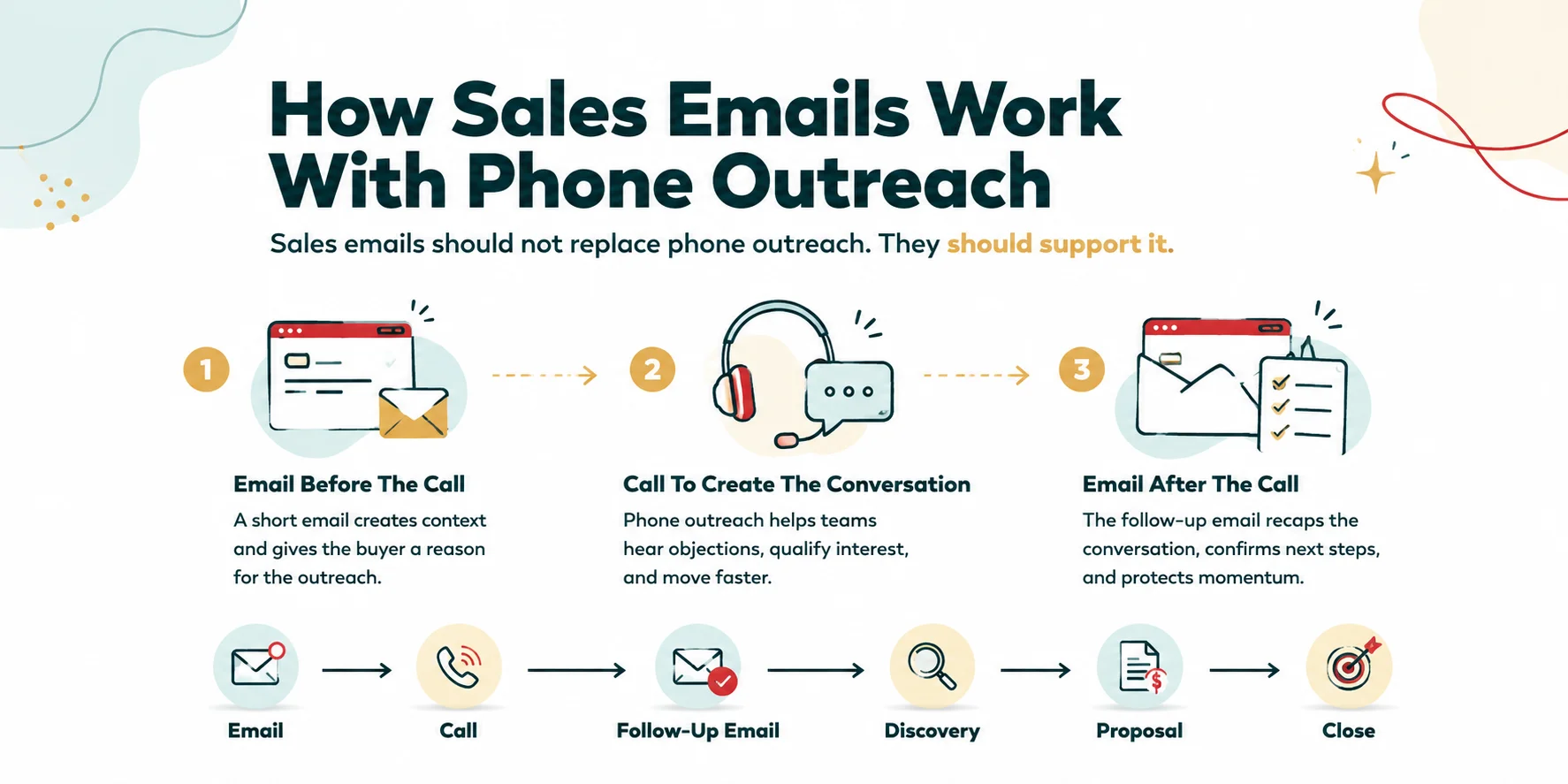
Sales emails should not replace phone outreach. They should support it. A stronger outbound system uses both channels with a clear purpose.
Email creates context. Calls create conversation. Follow-up emails protect momentum after the conversation happens.
Email Before The Call
A short email before calling can introduce the reason for outreach. It gives the buyer context and creates a reference point when the call happens.
The goal is not to make the email do all the selling. The goal is to make the next touch warmer.
Call To Create The Conversation
Phone outreach is where a team can hear objections, qualify interest, and move faster. A call creates feedback that email alone often cannot.
This is especially important for high-value services, complex offers, and buyers who need more context before taking action.
Email After The Call
The post-call email confirms what was discussed. It should recap the conversation, clarify next steps, and make sure both sides understand what happens next.
The simple sequence looks like this:
Email → Call → Follow-Up Email → Discovery → Proposal → Close
That is how sales emails become part of a real sales engine instead of isolated messages.
Sales Email Scorecard: Check Before You Send
A simple scorecard can help your team improve email quality before messages go out. It also creates a shared standard for what “good” looks like.
Score each email from 1 to 5 in these areas:
- Relevance
- Clarity
- Personalization
- Value
- CTA strength
- Length
- Tone
- Follow-up plan
If an email scores low on relevance or CTA strength, rewrite it before sending. Those two areas often decide whether the message creates movement or gets ignored.
Common Sales Email Mistakes
Most sales emails fail for predictable reasons. The message is too generic, too long, too self-focused, or too unclear about the next step.
Fixing these mistakes can improve results without needing a completely new campaign.
Sounding Too Generic
If the email could be sent to anyone, it will probably be ignored by most people. Specificity creates attention.
Even one relevant sentence can make the email feel more credible.
Writing Too Much
Long emails are harder to read and easier to delay. A sales email should not explain every detail of the offer.
It should create enough interest for the next step.
Asking For Too Much Too Soon
A cold prospect may not be ready for a 45-minute meeting. A softer CTA may work better early in the process.
Match the ask to the buyer’s level of awareness.
Forgetting To Follow Up
Many sales opportunities do not happen on the first email. Follow-up is part of the process, not a sign that the first message failed.
A strong follow-up adds context, value, or clarity. It should not simply repeat the same ask.
Ignoring Deliverability Basics
Even the best email will not work if it lands in spam or never reaches the inbox. Keep lists clean, avoid spam-heavy language, and make sure the sending setup is healthy.
Deliverability is not the exciting part of sales emails, but it matters.
How Upwind Thinks About Sales Email Templates
Upwind sees sales email templates as useful tools inside a larger system. They help teams move faster, stay consistent, and reduce the blank-page problem that slows execution.
The template is not the strategy. The strategy comes from knowing who you are targeting, why now is the right time to reach out, what problem you can help solve, and what next step makes sense.
That is why strong email templates work best when they are connected to phone outreach, CRM workflows, sales coaching, and follow-up discipline. When those pieces work together, emails become more than isolated touches. They become part of a structured pipeline-building motion.
For growing businesses, that structure matters. Better targeting improves relevance. Better phone outreach creates more conversations. Better follow-up keeps opportunities from slipping away. Better CRM systems make the whole process measurable.
That is the real value of a sales email system. Not more messages for the sake of more activity, but better communication that supports better pipeline movement.
Final Thoughts
Sales email templates still work when they are used the right way. They should act as frameworks, not scripts. They should help your team move faster while still sounding human, relevant, and specific.
The strongest sales emails do not try to close the entire deal in one message. They create a reply, start a conversation, confirm a next step, or keep a real opportunity moving.
If your team is building outbound, improving follow-up, or trying to make the sales process more consistent, templates can create useful leverage. But the real win comes when those templates are connected to the rest of the revenue engine.
Better emails create better conversations. Better conversations create cleaner pipeline. Cleaner pipeline gives your team a stronger path to growth.
FAQs
What Is A Sales Email Template?
A sales email template is a reusable email framework designed for a specific sales situation, such as cold outreach, follow-up, proposal review, or renewal. It gives the sender structure while still leaving room for personalization.
Do Sales Email Templates Still Work?
Yes, but only when they are adapted to the buyer and situation. Generic templates usually underperform. Templates work best when they include a relevant reason for outreach, a clear value message, and one simple CTA.
What Should A Sales Email Include?
A strong sales email should include a clear subject line, a relevant opening, a simple value message, and one call to action. It should be short enough to read quickly and specific enough to feel useful.
How Long Should A Sales Email Be?
Most sales emails should be brief. A few short paragraphs are usually enough. The goal is to create interest and move to the next step, not explain everything in the first message.
What Is A Good Subject Line For A Sales Email?
A good subject line is short, specific, and connected to the message. Examples include “Quick Question About [Company],” “Next Steps From Our Call,” or “Idea For [Business Area].”
How Many Follow-Up Emails Should You Send?
The right number depends on the buyer and sales cycle, but many teams use several follow-ups across email and phone. The key is to add value or context instead of repeating the same message.
How Do You Personalize A Sales Email Template?
Personalize the first line, the business problem, and the reason for outreach. You can use company signals, role-specific pain points, or recent activity to make the message feel relevant.
What Is The Best Sales Email Template For Cold Outreach?
The best cold outreach template is usually problem-aware, short, and easy to answer. It should show why you are reaching out, connect to a likely business issue, and ask for a simple next step.
Should Sales Emails Be Used With Cold Calling?
Yes. Sales emails and cold calls often work better together. Email can create context, calls can create real conversations, and follow-up emails can confirm next steps.
How Often Should You Update Sales Email Templates?
Templates should be updated whenever performance drops, buyer objections change, or the offer changes. Reviewing templates regularly helps keep messaging fresh, relevant, and aligned with the sales process.


.webp)
