


A sales forecast gives a business a clearer view of future revenue. It helps owners, sales leaders, and operators understand what is likely to close, when revenue may arrive, and where the pipeline needs attention.
Without a forecast, sales planning becomes reactive. Teams rely on hope, gut feeling, or scattered updates from reps instead of using a structured view of pipeline quality, deal timing, and expected revenue.
A strong sales forecast does more than predict a number. It shows whether the sales process is healthy. If the forecast keeps missing, the issue may not be the forecast itself. The real issue may be weak follow-up, poor qualification, unclear sales stages, or messy CRM data.
What Is A Sales Forecast?
A sales forecast is an estimate of future revenue over a specific period of time. That period could be a month, a quarter, a year, or a rolling forecast that updates continuously as new deals move through the pipeline.
The forecast is usually based on active opportunities, historical sales performance, close rates, average deal size, deal stage, sales cycle length, and market conditions.
A simple forecast might look like this:
Deal Value × Close Probability = Forecasted Revenue
For example, if a deal is worth $20,000 and has a 50% chance of closing, the forecasted revenue is $10,000. That does not mean the business will collect $10,000 from that deal. It means the expected value of that opportunity is $10,000 based on the current probability.
Sales forecasting helps the business move from vague optimism to structured planning.
Sales Forecast Vs. Sales Goal Vs. Sales Budget
These terms are often used together, but they do not mean the same thing. Understanding the difference keeps planning conversations cleaner and more useful.
A sales forecast predicts what is likely to happen. A sales goal defines what the company wants to happen. A sales budget shows how resources will be used to support the plan.
Sales Forecast
A sales forecast is based on available data. It looks at what is in the pipeline, how deals are progressing, and what revenue is likely within a certain period.
The forecast should be realistic. It should reflect what the business expects based on current information, not just what the team hopes to close.
Sales Goal
A sales goal is the target. It may be based on growth plans, revenue needs, hiring goals, or investor expectations.
Goals are useful because they create direction. But a goal is not the same as a forecast. A company can have a $1 million quarterly goal while the current forecast only supports $700,000.
Sales Budget
A sales budget is about planned spending. It may include headcount, tools, ads, sales enablement, CRM systems, travel, commissions, or outsourced support.
The budget should support the goal, but the forecast helps the business understand whether the current sales engine is on track to produce the expected revenue.
Why Sales Forecasting Matters
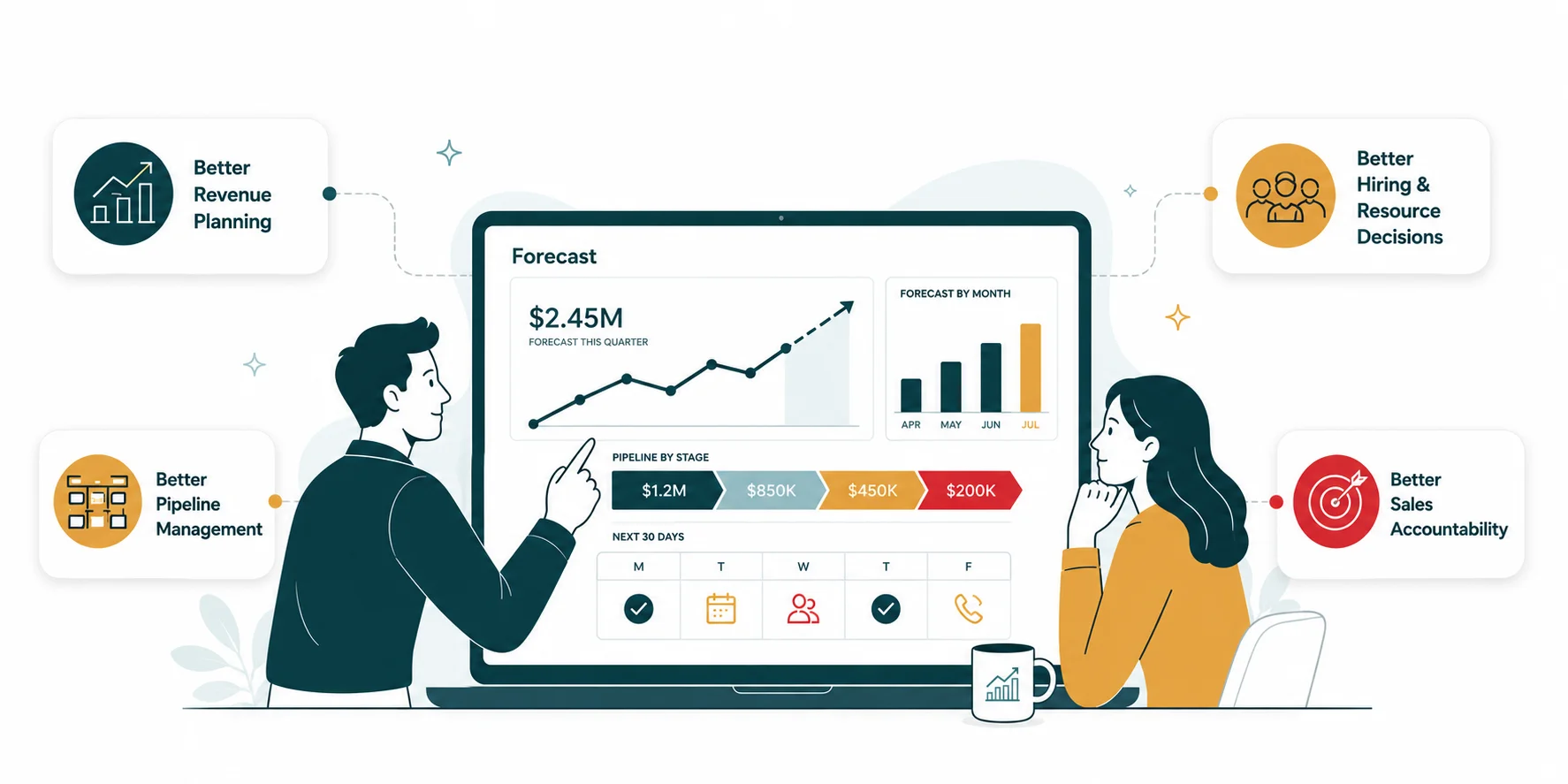
Sales forecasting is not just a reporting exercise. It helps the business make better decisions about cash flow, hiring, marketing spend, operations, and sales activity.
When the forecast is clear, the team can see where revenue is likely to come from and where gaps are forming.
Better Revenue Planning
A forecast helps the business understand expected revenue before it arrives. That gives owners and leaders more control over planning.
If the forecast shows a weak quarter ahead, the business can respond earlier. That might mean increasing outbound activity, improving follow-up, reactivating old leads, or adjusting spending before the problem becomes urgent.
Better Pipeline Management
A good forecast shows which deals need attention. It helps sales leaders see where opportunities are stuck, which reps need support, and which stages are too crowded.
That visibility makes pipeline reviews more useful. Instead of asking broad questions like “How is this deal going?” the team can talk about deal quality, next steps, probability, timing, and risk.
Better Hiring And Resource Decisions
Forecasting also supports operational planning. If revenue is expected to grow, the business may need more staff, more delivery capacity, or better systems.
If revenue is expected to slow, the business can avoid over-hiring or over-spending based on assumptions. That kind of planning matters for small and mid-sized businesses where cash flow decisions can affect the whole company.
Better Sales Accountability
A forecast gives the sales team a more concrete way to talk about performance. It makes expectations visible and helps everyone understand what needs to happen to hit the number.
This creates accountability without relying only on pressure. The conversation becomes more practical: which deals are real, which deals are weak, and what actions are needed now?
Who Uses A Sales Forecast?
A sales forecast helps more than the sales department. Revenue affects the entire business, so forecasting often supports decisions across leadership, finance, marketing, and operations.
The more connected the business becomes, the more useful the forecast becomes.
Business Owners And Executives
Owners and executives use sales forecasts to understand growth direction, cash flow, and risk. A forecast helps leadership see whether the company is likely to hit revenue targets and where action may be needed.
For operators, this is especially important. A forecast gives them a practical view of whether the business is moving toward predictable growth or still depending on scattered wins.
Sales Leaders
Sales leaders use forecasts to manage pipeline, coach reps, and plan activity. They need to know which opportunities are likely to close, which deals are at risk, and where the team may need more support.
A forecast also helps leaders separate real pipeline from inflated pipeline. That distinction matters when making decisions about quota, staffing, and sales strategy.
Sales Reps
Sales reps use forecasts to manage their own book of business. A clear forecast helps them prioritize the right deals, update close dates, and stay honest about deal probability.
It also helps reps prepare for pipeline reviews. Instead of relying on memory, they can use clean deal data and confirmed next steps.
Marketing And Operations
Marketing teams can use forecast data to understand which lead sources are turning into real revenue. Operations teams can use it to prepare for delivery, staffing, inventory, or customer support needs.
When forecasting is done well, the whole business gets a better view of what is coming next.
What Data Do You Need To Build A Sales Forecast?
A forecast is only as strong as the information behind it. If the pipeline is messy or deal stages are unclear, the forecast will be unreliable.
The goal is not to collect every possible data point. The goal is to collect the information that helps predict revenue more accurately.
Useful forecast data includes:
- Current pipeline value
- Deal stage
- Close probability
- Expected close date
- Average deal size
- Average sales cycle length
- Historical close rate
- Lead source
- Next step date
- Seasonality
- Market changes
- Sales rep notes
The most important fields are usually deal value, stage, probability, close date, and next step. If those fields are not accurate, the forecast will usually drift away from reality.
How To Create A Sales Forecast Step By Step
Sales forecasting does not need to be complicated at the beginning. A simple process, used consistently, is usually better than a complex model nobody trusts.
The goal is to create a forecast the team can maintain and improve over time.
Step 1: Define The Forecast Period
Start by deciding what time period you want to forecast. Many businesses forecast monthly, quarterly, or annually.
A monthly forecast can help with short-term cash flow and activity planning. A quarterly forecast is often better for sales leadership and strategic planning. A rolling forecast can work well for teams that want constant visibility.
Step 2: Clean Up Your Pipeline
Before forecasting, review the pipeline. Remove stale deals, update close dates, confirm deal values, and check whether each opportunity has a real next step.
This step matters because bad pipeline data creates bad forecasts. If old deals stay open forever, the forecast will look stronger than it actually is.
Step 3: Choose A Forecasting Method
Pick a method that fits your business. A newer company may use a simpler method based on rep judgment and active pipeline. A mature company may use historical data, stage probabilities, and sales cycle patterns.
The right method depends on data quality, sales volume, and how predictable the sales process already is.
Step 4: Assign Probabilities
Each opportunity should have a close probability. This can be based on the sales stage, the rep’s assessment, or historical close rates.
For example, a discovery-stage deal may have a 25% probability, while a proposal-stage deal may have a 60% probability. A verbal yes may sit closer to 80% or 90%, depending on how the business defines that stage.
Step 5: Calculate Expected Revenue
Once the deal value and probability are clear, calculate expected revenue.
Example:
A $30,000 deal with a 40% probability creates $12,000 in forecasted revenue.
A $10,000 deal with an 80% probability creates $8,000 in forecasted revenue.
Add the expected value of all qualified opportunities in the forecast period, and you have a basic forecast.
Step 6: Review And Adjust Regularly
A forecast should not be created once and forgotten. Deals move, buyers delay, new opportunities enter the pipeline, and close dates change.
For many teams, a weekly forecast review works best. For longer sales cycles, biweekly or monthly reviews may be enough. The key is consistency.
Common Sales Forecasting Methods
There are several ways to forecast sales. Some are simple and useful for small businesses. Others require stronger historical data, cleaner CRM systems, or larger deal volume.
The best method is the one your team can use accurately and consistently.
Historical Forecasting
Historical forecasting uses past performance to predict future sales. If the company usually closes $200,000 in Q2, it may use that number as a baseline for the next Q2.
This method works best when sales are stable and past performance is a reliable indicator. It is less useful when the business is changing quickly or entering a new market.
Pipeline Forecasting
Pipeline forecasting uses current open opportunities to estimate future revenue. It looks at deal value, probability, and expected close date.
This is one of the most useful methods for sales-led businesses because it connects forecasting directly to active opportunities.
Opportunity Stage Forecasting
Opportunity stage forecasting assigns probabilities to each sales stage. For example, discovery might be 25%, proposal might be 60%, and contract review might be 85%.
This method works well when sales stages are clearly defined. If every rep interprets stages differently, the forecast becomes less reliable.
Length Of Sales Cycle Forecasting
This method estimates future revenue based on how long deals usually take to close. If a company’s average sales cycle is 60 days, a deal that entered the pipeline last week is less likely to close this month than one that has been active for 55 days.
This method works best when sales cycles are fairly consistent.
Intuitive Forecasting
Intuitive forecasting relies on sales rep judgment. The rep estimates whether a deal will close based on their understanding of the buyer, relationship, and opportunity.
This can be useful when data is limited, but it needs careful management. Without structure, intuitive forecasting can become too optimistic.
Scenario Forecasting
Scenario forecasting creates multiple versions of the forecast. A business may build a conservative, expected, and aggressive forecast.
This is useful when planning around uncertainty. It helps owners and leaders understand what happens if deals move slower, faster, or differently than expected.
AI Or Predictive Forecasting
AI or predictive forecasting uses larger data sets to identify patterns and forecast outcomes. This can be useful for larger teams with strong CRM data and enough sales activity to train meaningful models.
For smaller businesses, AI forecasting is only as useful as the data behind it. If the CRM is messy, the prediction will be weak.
Sales Forecast Example
A simple forecast example makes the concept easier to understand. Imagine a service business reviewing expected revenue for the next month.
The total pipeline value is $54,500. But the forecasted revenue is $31,050 because each deal is weighted by its probability.
This is important. Pipeline value and forecasted revenue are not the same thing. Pipeline value shows what could happen. Forecasted revenue estimates what is more likely to happen.
Sales Forecasting For Small Businesses
Small businesses do not need an enterprise-level forecasting model to benefit from sales forecasting. They need clean data, clear stages, and a consistent review process.
A simple forecast can be built with a CRM or even a spreadsheet at the beginning. What matters most is that the team updates it regularly and uses the same definitions.
For a small business, the first forecast should usually track:
- Deal name
- Deal value
- Lead source
- Sales stage
- Close probability
- Expected close date
- Next step
- Owner
This gives the owner or sales leader enough visibility to understand what revenue may come in and where the pipeline needs support.
Small businesses often struggle with forecasting because the sales process lives in someone’s head. Once the process is documented and the pipeline is visible, forecasting becomes much easier to improve.
Why Sales Forecasts Are Often Wrong
Sales forecasts are rarely wrong because someone failed to build a spreadsheet. They are usually wrong because the sales process behind the spreadsheet is weak.
If the inputs are unreliable, the output will be unreliable too.
The Pipeline Is Not Clean
Old deals often stay open long after they should be removed. Reps may avoid closing lost opportunities because they want the pipeline to look full.
This makes the forecast look stronger than reality.
Sales Stages Are Too Vague
If “qualified” means one thing to one rep and something different to another, stage-based forecasting will not work.
Clear stage definitions matter. A deal should only move forward when it meets the criteria for that stage.
Close Rates Are Based On Hope
Probabilities should be based on patterns, not optimism. If a rep assigns every proposal an 80% chance of closing, the forecast will almost always be inflated.
The business needs to compare probabilities against actual close rates over time.
Follow-Up Is Weak
Many deals do not stall because buyers lost interest. They stall because the next step was never clearly confirmed.
Weak follow-up creates uncertainty, and uncertainty hurts forecast accuracy.
Sales Cycle Length Is Ignored
A deal may be real, but that does not mean it will close inside the forecast period. Timing matters just as much as deal quality.
A good forecast accounts for when revenue is likely to close, not just whether it may close eventually.
How To Improve Sales Forecast Accuracy
Improving forecast accuracy usually starts with improving sales process discipline. Better data, clearer stages, and stronger follow-up all make the forecast more reliable.
Accuracy improves when the team stops treating forecasting as a reporting task and starts treating it as a sales system habit.
Define Sales Stages Clearly
Each stage should have specific criteria. A deal should not move to proposal just because the rep wants it to. It should move because the buyer has shared enough information to justify that step.
Clear stages make probability more meaningful.
Keep CRM Data Updated
CRM data should reflect reality. Deal value, close date, next step, stage, and contact information should be current.
If reps update the CRM only before a meeting with leadership, the forecast will always lag behind the truth.
Track Lead Source And Close Rate
Forecasting improves when the business understands which lead sources produce real revenue. A referral lead may close differently than a cold outbound lead or a paid ad lead.
Tracking lead source helps the company forecast more accurately and invest more wisely.
Review Pipeline Weekly
Weekly pipeline reviews help catch issues early. They also build accountability around next steps, stale deals, and forecast changes.
The goal is not to pressure reps. The goal is to keep the forecast connected to reality.
Confirm Next Steps After Every Sales Call
Every active opportunity should have a next step. If the next step is vague, the deal is at risk.
Clear post-call follow-up improves the buyer experience and helps keep the pipeline more accurate.
Upwind Perspective: Forecasting Is A Sales Engine Problem
A sales forecast is not just a number inside a spreadsheet or CRM. It is the output of the sales engine behind it. If the engine is inconsistent, the forecast will be inconsistent too.
Upwind offers professional sales consulting services for businesses that need better pipeline visibility, stronger sales processes, cleaner follow-up systems, and more predictable revenue growth. The work is not only about forecasting the future. It is about building the systems that make the future easier to predict.
That includes improving how leads are generated, how prospects are contacted, how calls are handled, how opportunities are qualified, and how the CRM is maintained. A better forecast starts with better sales execution.
When outreach, follow-up, CRM discipline, and pipeline reviews work together, leadership gets a clearer view of what is likely to happen. That is where forecasting becomes more useful. It stops being a guessing exercise and starts becoming a growth management tool.
Tools For Sales Forecasting
Sales forecasting can be done with several tools. The right choice depends on company size, sales complexity, and how much data the business already has.
The tool matters, but the process matters more. A clean spreadsheet can outperform an expensive CRM if the team actually keeps it updated.
CRM Systems
A CRM is usually the best place to manage sales forecasting once a business has consistent deal flow. It can track stages, deal values, close dates, rep ownership, notes, and activity history.
The CRM becomes especially valuable when the team uses it consistently.
Spreadsheets
Spreadsheets can work for early-stage or very small teams. They are flexible, simple, and easy to customize.
The downside is that spreadsheets are easier to break, harder to automate, and more dependent on manual updates.
Sales Forecasting Software
Dedicated forecasting software can help larger teams model revenue, track forecast changes, and analyze deal risk.
These tools are most useful when the business already has enough data and process maturity to benefit from advanced reporting.
BI Dashboards
Business intelligence dashboards can combine sales, marketing, finance, and operations data into one view.
This is useful for companies that want to connect forecasting with broader business planning.
Sales Forecasting Mistakes To Avoid
Forecasting gets weaker when teams skip the basics. The most common mistakes are usually simple, but they create major planning issues over time.
Avoid these mistakes:
- Confusing sales goals with sales forecasts
- Letting stale deals stay in the pipeline
- Using vague sales stages
- Assigning probabilities based on hope
- Ignoring sales cycle length
- Forgetting to update close dates
- Failing to confirm next steps
- Relying only on spreadsheets as the team grows
- Never measuring forecast accuracy
Fixing these habits can dramatically improve forecast quality.
Final Takeaway
A sales forecast predicts future revenue based on pipeline, probability, timing, historical data, and sales process quality. It helps the business plan better, manage pipeline more effectively, and make smarter decisions about growth.
The best forecasts are not built from guesses. They are built from clean data, clear stages, consistent follow-up, and honest pipeline reviews.
Predictable revenue starts with predictable systems. When the sales process becomes clearer, the forecast becomes more reliable. When the forecast becomes more reliable, the business can make better decisions about what to do next.
FAQs
What Is A Sales Forecast In Simple Terms?
A sales forecast is an estimate of how much revenue a business is likely to generate in a future period. It is based on current opportunities, close rates, sales cycle length, and historical performance.
What Is The Difference Between A Sales Forecast And A Sales Goal?
A sales forecast predicts what is likely to happen. A sales goal defines what the business wants to achieve. The forecast should be realistic, while the goal is the target the team is working toward.
How Do You Calculate A Sales Forecast?
A simple formula is deal value multiplied by close probability. For example, a $20,000 deal with a 50% probability creates $10,000 in forecasted revenue.
What Is The Best Sales Forecasting Method?
The best method depends on your business. Pipeline forecasting and opportunity stage forecasting are useful for many sales-led businesses. Historical forecasting works well when past sales are consistent.
How Often Should A Sales Forecast Be Updated?
Many teams update forecasts weekly. Businesses with longer sales cycles may review them biweekly or monthly. The forecast should be updated often enough to reflect real pipeline movement.
Can Small Businesses Use Sales Forecasting?
Yes. Small businesses can start with a simple forecast using deal value, stage, probability, close date, and next step. A basic forecast is often enough to improve planning and pipeline visibility.
Why Are Sales Forecasts Often Inaccurate?
Forecasts are often inaccurate because CRM data is outdated, sales stages are vague, stale deals stay open, close dates are unrealistic, or reps assign probabilities based on optimism instead of evidence.
What Tools Can You Use For Sales Forecasting?
Businesses can use spreadsheets, CRM systems, forecasting software, or BI dashboards. The right tool depends on team size, sales complexity, and data quality.


.webp)
